Fuzoku Kitan
August 1960
← Back to magazine archive
Issue Details
- Issue
- 8
- PDF pages
- 118
Summary
The August 1960 issue of Fūzoku Kitan combines two dominant editorial programs: a special feature on lesbian life and techniques of same-sex love, and a broad collection of supernatural, grotesque, sadomasochistic, and sensational narratives. The cover announces both the lesbian feature and a collection of frightening stories about ghosts and uncanny transformations. As in other issues of the magazine, purported sexology, personal testimony, historical anecdote, fiction, crime reporting, and staged erotic imagery occupy the same editorial terrain.
Read full summary Close full summary
Table of Contents 38 items
-
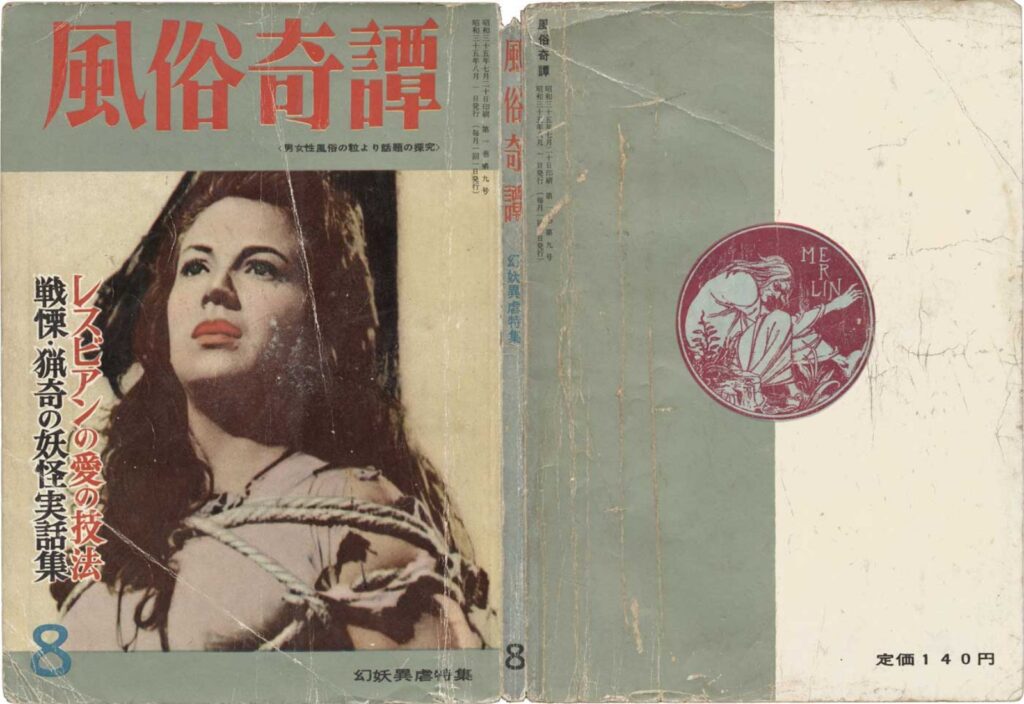
August 1960 Cover: Special Issue on the Fantastic, Supernatural, Strange, and Cruel
Summary
The cover presents the August 1960 special issue through a dramatic portrait of a woman and prominent Japanese text highlighting fantastic, supernatural, strange, cruel, and lesbian erotic themes.
-
Japanese Erotic Prints: A Secret Meeting and Woman’s True Nature
Summary
This visual feature reproduces two Japanese erotic prints depicting intimate encounters, including a clandestine meeting and an image framed as revealing women’s sexual nature.
-
Formal Table of Contents
Summary
The formal contents page inventories the issue’s articles and features, including essays, fiction, visual material, reportage, and a special section on lesbian erotic techniques.
-
Western Erotic Illustration
Summary
A feature presenting Western erotic illustration, centered on stylized depictions of women and intimate erotic scenes.
-
Double Binding
Summary
A photographic bondage feature showing multiple women arranged in elaborate rope restraints and staged poses, accompanied by Japanese explanatory text.
-
The Woman’s Pleasure
Summary
An illustrated erotic scene depicting restrained women in a theatrical interior setting, framing bondage and female eroticism through a dramatic visual composition.
-
Nude Woman at the Stand
Summary
A staged photographic feature depicts a nude woman posed and restrained on a stand in several positions, with ropes and furniture forming the setting and accompanying captions emphasizing the scene’s unusual atmosphere.
-
Soft-Skin Binding
Summary
A photographic feature presents a woman in minimal clothing secured in a series of rope and apparatus-based positions, including bound and reclining poses, under the heading “Soft-Skin Binding.”
-
Bamboo Torment
Summary
“Bamboo Torment” depicts staged scenes in which a woman is bound with rope to bamboo poles and positioned on the floor or within a crossed-pole framework.
-
Among Fallen Flowers
Summary
A photographic bondage feature presents a woman restrained with rope in a series of reclining and contorted poses on a bed, accompanied by poetic Japanese text about fallen flowers and sensual distress.
-
Bathrobe Bondage
Summary
A staged photographic sequence shows a woman in a striped bathrobe bound with rope around her torso and limbs in various seated, kneeling, and floor-bound positions.
-
Both Hands Suspended
Summary
A photographic feature depicts women subjected to rope restraint and suspension-like poses, including raised-arm bindings, bound legs, and restrictive postures in an interior setting.
-
White Skin of Pleasurable Cruelty
Summary
A photographic feature portraying a woman bound with rope in varied seated, standing, and reclining poses, framing restraint as an aestheticized experience of pleasurable cruelty.
-
Overflowing Enchanted Beauty
Summary
A visual feature presenting images of a woman tightly rope-bound in composed, reclining poses that emphasize physical beauty emerging through restraint.
-
The Posture of the Arms Behind the Back
Summary
A photographic study of “arms-behind-the-back” restraint, showing multiple rope-bound postures and the formal variations produced by different ties and body positions.
-
Folded in Two
Summary
A photographic feature presents women bound with rope in tightly folded, contorted positions, accompanied by commentary framing restraint and forced folding as an erotic practice.
-
Cruelty in a Ruined Hut
Summary
An erotic illustration depicts a woman stripped and tied with her arms behind her to a post in a dilapidated hut, emphasizing an atmosphere of cruelty and captivity.
-
The Needle Woman’s Ordeal
Summary
An erotic illustration portrays a young seamstress in an abandoned sewing room, with her clothing opened, body restrained by rope, and mouth secured with a gag.
-
Winch Suspension
Summary
An erotic torture illustration depicts a nude woman folded, bound with chains, and hoisted by a winch above a large boiling cauldron.
-
Pulley Torment
Summary
An erotic torture illustration shows a woman tied to a stake while a pulley rope attached to her hair pulls her upward, producing an agonizing suspension and splitting effect.
-
August Issue Title Page
Summary
The title page announces the August issue of Fuzoku Kitan as a special feature on the fantastic, supernatural, strange, and cruel, accompanied by an erotic illustration of a couple.
-
The Reality of Lesbians
Summary
A pseudo-sexological survey of lesbian identity and relationships, combining generalized claims about women’s same-sex desire with reported cases involving schoolgirls, married women, prisoners, and women who later marry men or become pregnant.
-
Techniques of Lesbian Love in East and West
Summary
An erotic reportage and advice feature comparing lesbian relationships in East and West through interviews, case histories, photographs, and descriptions of affectionate and sexual techniques, including kissing, touching, breast stimulation, and role dynamics.
-
Lesbienne
Summary
An illustrated dialogue and advice section presenting lesbian romance and intimacy through conversational scenarios, emphasizing emotional attachment, secrecy, kissing, caressing, and other forms of physical affection between women.
-
Invitation to Lesbos
Summary
An essay surveys representations and experiences of female same-sex desire, moving from Sappho and Lesbos through literary works and modern cultural examples, with an accompanying erotic image.
-
Sunflower
Summary
A grotesque erotic story follows Yumi and Kazuma through escalating coercion, sadistic violence, murder, and the use of a corpse to nourish a sunflower blooming in midsummer.
-
A History of Sexual Curiosities in the Meiji Period, Part 7
Summary
The seventh installment compiles sensational Meiji-era reports of sexual and domestic curiosities, including apparent poltergeist phenomena, poison murder, staged or attempted double suicide, and violent encounters involving couples and strangers.
-
How I Became Interested in Panties
Summary
An autobiographical account traces the author’s fascination with women’s panties from childhood curiosity through adolescent experimentation and adult fetishistic desire, including the role of secrecy, domestic life, and purchasing lingerie.
-
Supernatural Transformations and Sex
Summary
This cultural essay examines supernatural transformations and sexual symbolism in Chinese and Japanese folklore, discussing yokai, ghosts, spirits, fire phenomena, and the historical anxieties projected onto gender and sexuality.
-
The Dead Spirit That Possessed a Young Woman
Summary
A first-person supernatural narrative recounts a young woman’s apparent possession by the spirit of a dead girl, with family members consulting a fortune-teller and struggling to distinguish illness, dreams, and haunting.
-
The Man Summoned by the Vengeful Spirit of a Woman He Killed
Summary
A sensational account follows a man haunted and sexually manipulated by the vengeful spirit of a woman he murdered, blending police investigation, guilt, possession, and violent retribution.
-
Tales of Supernatural Transformations from Across Japan
Summary
This collection presents folkloric tales from across Japan in which ghosts, animal spirits, and other supernatural beings transform, seduce, pursue, or punish human characters.
-
The Man and Woman Avenged by a Ghost
Summary
Set in the Edo period, this illustrated supernatural narrative follows a man and woman whose encounters with a murdered woman’s ghost lead to erotic coercion, bodily terror, revenge, and eventual punishment.
-
Dressing-Room Conversations
Summary
An observational essay about sexually suggestive and unusual behavior in public dressing rooms and toilets, including voyeurism, urination-related conduct, and the psychological motives attributed to such acts.
-
Strange Tales of Pearl-Diving Women
Summary
An erotic adventure narrative set on a remote island, where a male visitor encounters pearl-diving women and becomes involved in increasingly coercive and sexually charged encounters; the story is accompanied by erotic illustrations.
-
The Cutting of a Boy’s Buttocks: Noguchi Otokosaburō
Summary
A historical crime report on Noguchi Otokosaburō, recounting a notorious case involving the mutilation and murder of a boy and tracing the suspect’s later sexual obsessions, relationships, deceptions, investigation, and trial.
-
Readers’ Salon
Summary
The Readers’ Salon presents correspondence between readers and the editors, including reactions to the magazine’s imagery and special issues, requests for photographs and illustrations, personal accounts, and editorial replies about submissions and publication plans.
-
Publication Notices and Colophon
Summary
Publication notices advertise current and forthcoming Fuzoku Kitan special issues and related illustrated volumes, listing their themes and contents alongside publisher, pricing, ordering, and colophon information.
Highlights
- The opening visual section combines Japanese erotic-print reproductions, a formal contents spread, Western erotic imagery, and color and monochrome bondage photography. (PDF pp. 2–7).
- A lengthy gravure portfolio stages women in standing, seated, recumbent, bamboo-frame, bathrobe, overhead-wrist, and compact doubled bondage positions. (PDF pp. 6–26).
- Ejima Hidehisa contributes four full-page bondage illustrations depicting cruelty in a ruined hut, punishment with a mannequin-like apparatus, winch suspension, and pulley restraint. (PDF pp. 27–30).
- Ōtachi Kinji’s lead feature surveys forms of lesbian relationships, sexual techniques, masculine and feminine roles, married women, prostitution, schools, and institutional environments. (PDF pp. 32–35).
- Kabiya Kazuhiko’s extended essay combines case histories, correspondence, social observation, and descriptions of lesbian courtship and physical intimacy in Japan and abroad. (PDF pp. 36–45).
- Nanbara Kiyoshi’s “Sunflower” presents a macabre vision of a corpse becoming fertilizer for luxuriant flowers, joining eroticized violence to supernatural horror. (PDF pp. 50–53).
- The Meiji-period sexual-curiosity series reproduces and discusses historical reports of erotic crimes, scandals, unusual deaths, and bizarre incidents. (PDF pp. 54–58).
- The later supernatural sequence includes ghost possession, vengeful spirits, yōkai transformations, animal-spirit legends, corpse imagery, and revenge from beyond the grave. (PDF pp. 64–94).
- The final major historical feature investigates the mutilation of a boy’s buttocks and places the case within Meiji, Taishō, and early Shōwa crime history. (PDF pp. 104–115).
- Reader correspondence, editorial responses, advertisements, forthcoming-publication notices, and the colophon close the issue. (PDF pp. 116–118).
Contributors
Named contributors represented in this issue: