Article Summary
This illustrated comic-erotic story begins with a man and a café waitress, Kaoru, discussing a newspaper account of Chinese women allegedly kidnapped, confined in beer barrels, transported by ship, and sold in Canton. During a holiday visit to a Chinese restaurant, alcohol, an accommodating proprietor named Chen, a storeroom, ropes, and an empty barrel turn the reported trafficking narrative into improvised role-play. Kaoru removes her outer kimono, is bound over her scarlet nagajuban, gagged, placed in the barrel, blindfolded, tied to a pillar, and presented in a mock slave auction. The story ends with the participants returning safely to Tokyo and Kaoru admitting a conflicted fascination with being bound, inspected, and symbolically sold. Historically, the article is notable for showing how mid-1950s Kitan Club converted sensational newspaper material, orientalist images of China, kimono display, and bondage fantasy into a self-conscious theatrical scene. It also illustrates the magazine's recurring interest in the relationship between purported documentary reports and staged erotic reenactment. The comedy depends heavily on drunken banter, parody Chinese-inflected Japanese, and the unstable boundary between Kaoru's spoken objections, voluntary participation, embarrassment, and curiosity.
Translation
[PDF viewer page 49]
Kimono Series
The Bride Has Arrived
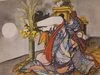
By Shirogane Kōji; illustrations credited in the scan to Takigane Kinji.
“So what happened after that?”
“What happened? She probably became the wife of some coolie or rickshaw puller.”
“But that is a dreadful story. Is it really true?”
“It seems to be. Look, it says it was translated and excerpted from a Ta Kung Pao report. The Chinese wording is all gobbledygook to me, but it is interesting, isn’t it?”
“I do not find it interesting at all. But how could they bring over so many women?”
“That is the business. They spread a net, and there are accomplices all along the route. It is apparently quite easy. A girl is quickly deceived, even someone like you.”
“Do not be ridiculous. I would be perfectly safe. I would bite every hand and foot that came near me. But would you do it too, if someone said there was money in it?”
“Who knows? I might, if the girl were pretty enough.”
“How awful! Do not look at me like that. Men are all hateful creatures. Your tea has gone cold. Shall I bring you a hot one?”
By October, the streets of Tokyo were beginning to turn chilly. While city people went off in high spirits to see chrysanthemum dolls and autumn leaves, the Suzurantei coffee shop, where I stopped on my way home from an oil-smelling factory, was one of my own oases, finer than the autumn foliage itself.
Among its three waitresses, Kaoru ranked perhaps third in facial beauty. To make up for that, she needed some other attraction, whether a fine figure or a winning manner. Like many women of her profession, she was friendly and possessed a strikingly substantial body. The full weight of her figure pressing forward beneath a white apron and red obi accessory was exactly what had first caught my attention.
That evening the proprietor was away buying supplies. Apart from us, only a student in a cloak sat quietly listening to records. The room had the deserted calm of the beginning of the week, and I could enjoy a few moments alone with Kaoru.
[PDF viewer page 50]
“Beer barrels are small, are they not? Wouldn’t they roll about?”
“They may be small, but a woman can be put inside if someone is determined. That is the convenient thing about women.”
“But when the girl in the story died, they had broken her bones one after another.”
“Come now, I am still alive.”
“Would she remain in the barrel the whole time?”
“Not necessarily. Once they had loaded the women aboard, they could take them out. The account says they were examined one by one. When one went to relieve herself, another accompanied her to a chamber pot in the corner of the sweltering hold. It sounds as though they were transported by ship. The reference to women from America, or perhaps ‘beautiful barbarians,’ is difficult to decipher, but it seems they wore only a single Chinese gown.”
“How horrible. How many days did it take them to arrive?”
“They passed the Zhoushan Islands and reached Canton after about fifty days. They had to stop for salt and rice, or something of that sort. The episode must have taken place in winter. It says a sailor slipped on deck and became covered with snow. When the beer barrels were unloaded ashore…”
“Tell me the rest. Madame interrupted before, and I missed it. It is frightening, but I want to hear it.”
“Do not be absurd. A moment ago you said you hated the story.”
“I hate it, but I still want to know. That is how women are with one another.”
“Let us leave it for today. Would you not like to eat genuine Chinese food instead? You said you wanted to try it sometime. I know a place that is cheap and good.”
By a curious coincidence, it was the Double Tenth holiday. The factory was closed, my wife had returned to Shinshū for the birth of our child, and Kaoru had a day off after the shop’s major cleaning. Since I had boasted that I knew a cheap and excellent restaurant, there was no retreat. In truth, I had scarcely ventured beyond Shinagawa before. The sweat I worked up had less to do with the autumn season than with the packed train.
As we rode along the waterfront, Kaoru adjusted the thick collar of her coat and said, “It is cold. I am glad I wore this.” Unlike the women in fashionable magazines, she still belonged unmistakably to the tribe of the Yamato nadeshiko.
When the train stopped around Sakuragichō, we followed the crowd out of the station. A strong smell of oil struck our noses. After turning through several street corners, entering a narrow alley, and turning right at the fourth utility pole, we found a restaurant whose sign could be read as something like ‘Zi Restaurant,’ in a district where the buildings stood tightly packed together.
“You found it very well,” the proprietor said. “This neighborhood is hard to understand on a first visit. Please come upstairs. You have brought such a pretty guniang. Do not be shy. Shall I put you in a room on the second floor?”
Mr. Chen was so stout and greasy that the whole house seemed congealed from the fat spilling out of him. Everything about the place naturally looked exotic, but its unusually gaudy decoration was apparently for the Double Tenth celebrations.
“Stay and enjoy yourselves,” he said. “It is a Chinese holiday. What shall I serve? Chinese noodles, ramen, fried rice, or something finer? Leave it to me. Ha, ha, ha!”
“Your restaurant seems prosperous, Mr. Chen. Do many people from your country come here?”
“No, many Japanese customers too, especially prosperous politicians. People of many countries come. Tonight is especially lively. Stay until late. Firecrackers and dancing all night.”
[PDF viewer page 51]
“This is real Chinese cooking,” Chen continued, “different from ordinary Peking-style food. Can you tell?”
Kaoru had already begun to relax under the effects of the strong Chinese liquor Chen kept pouring. What had started as a formal “Pleased to meet you” became: “So your name is Mr. Chen? This is delicious. I have already had another cup. It is wonderful. China is so different from Tokyo and very interesting.” Her cheeks were flushed, and she had grown considerably more animated.
At this rate, another half hour would leave her ready for almost anything.
“Mr. Chen,” she said, “that earlier story was the one we were discussing, was it not? It frightens me, but women really were brought to places like this in China, were they not?”
“Ask your gentleman. I am from Canton myself. Such things…”
Chen’s explanation came in such rapid speech that neither Kaoru nor I could follow it properly. I was already having trouble enough with the unfamiliar dishes.
[PDF viewer page 52]
“How dreadful,” Kaoru said.
“What is dreadful?” Chen asked, appearing between the tables while issuing brisk orders to his employees.
“That old story,” he continued. “It is an old story. It does not happen now. A beautiful guniang like you, though, must be careful. Ha, ha, ha!”
“You see, Mr. Chen,” I said, “this girl is quite a performer. That slave auction in the article has fascinated her.”
“I want to try it,” Kaoru declared.
“That is not what I said!”
“You were wondering whether you would become someone’s concubine,” I teased, “and whether they would pack you into a beer barrel.”
“Ha, ha, ha! Pack her in a barrel? Very good. Shall I show you a beer barrel?”
We descended the restaurant’s dim stairs and made our way cautiously along a corridor scarcely wide enough for one person. Chen opened a damp-smelling door. The room beyond served as both storeroom and office. When he threw the switch, an electric bulb lit it brightly. A hostile observer might have taken it for a chamber used for secret discussions or gambling.
Several large beer barrels were stacked where Chen pointed.
“What a coincidence,” he said with a grin. “They have been washed. Are they not like the beer barrels in the story?”
“They are larger than I expected,” I said. “What do you say, Kaoru? Shall we try one?”
The alcohol certainly helped. We were isolated from the restaurant, and an unexpected collection of useful objects lay at hand. Alcohol, it seems, can turn men and women into itinerant actors.
“I will do it!” Kaoru said.
Once she had agreed, the entire atmosphere changed. Our little private corner grew into an unexplored theatrical world, and the evening acquired an entertainment none of us had anticipated.
“Then you are a girl who has been kidnapped and brought here,” I said. “That is where the scene begins.”
“All right.”
I gathered whatever could be found nearby: rope, a table, and a platform, all makeshift stage properties.
“Mr. Chen, are you busy? We want to act out that story in here. I am sorry to make such a commotion.”
“I come back later,” he said. “Use room. Shut door firmly. Chinese food still coming. Very good.”
He laughed cheerfully and returned to the restaurant.
“I am completely drunk,” Kaoru said. “May I stagger? This is my first time. Do I climb straight into the beer barrel?”
“Not yet. A kidnapped girl would first be treated like this.”
“That hurts! Through my kimono? And you are tying both my hands? You are awful.”
“It will not feel authentic otherwise.”
Over Kaoru’s lined meisen kimono, I wound a thin rope twice around her chest and above her obi. Then I smacked her backside.
“Imagine you have been carried into a warehouse on a steamer wharf. My acting is poor, but play along.”
Had a truly gifted director been present, the setting might have produced a scene beyond the expectations of even the most discriminating connoisseur.
“Quiet, all of you!” I shouted in character. “Crying and screaming will do you no good. Obey what we tell you.”
[PDF viewer page 53]
“No! Let me go home!”
“Let you go? Do not make me laugh. We paid good money for you. Bear it for a while, and eventually we will make things easier for you.”
“Boss, it seems the cargo has arrived.”
“Then prepare it immediately.”
I pretended that girls were being dragged one by one from a ship’s hold, collapsing in tears.
“Only a little longer. Your clothes are too hot and cumbersome. Undo your obi. You are embarrassed? It is far too late for modesty now. Take it off, quickly.”
Rubbing her wrists as though they had gone numb from the ropes, Kaoru reluctantly removed her imitation Nishijin Nagoya obi, the red obi accessory, and the arrow-patterned cord, then slipped off her lined silk kimono. Beneath it she wore a scarlet nagajuban patterned with white bush clover.
“Is that borrowed?”
“No, it is mine. Is it pretty?”
Even at this stage, she retained her playful spirit.
“Good. Next step.”
“You have caused trouble from the moment you arrived. Put your hands behind your back and behave.”
I brought her wrists together behind her, bound them, and tightened the rope around her upper arms and across the line of her breasts. Her arms were secured in a double rear binding.
“You are really tying me! That is enough.”
“To keep you from talking so sweetly, bite down on this.”
I pushed a gag into her mouth and tied a strip of cloth over it.
“This treasure is heavy. Give me a hand. Heave-ho! The barrel, quickly. We must pack her before anyone comes.”
Playing both roles, I lifted Kaoru’s heavy body. I swept the hem of her nagajuban forward out of the way and tried to lower her, still in her tabi, into the barrel.
“The five-hundred-yuan merchandise will be damaged,” I said in another voice.
“Do not worry. The workmanship is perfect. Handle expensive goods carefully. There now, do not cry. Do not dirty your pretty clothes, and stop struggling.”
[PDF viewer page 54]
The barrel was narrower than it had appeared. Putting a woman inside while her hands were tied behind her was not easy. Kaoru looked up with pitiful eyes. The more we struggled, the more her hair collapsed into disorder. Pink underclothing slipped into view, and beneath it flashes of a bright-red wool waistcloth appeared. Her face gradually reddened with embarrassment.
Her rounded hips fitted tightly against the rim. I took hold of the date-maki at her back and pushed downward. With a sudden pop, her plump body dropped into the barrel.
“We have no further use for her at present. It seems rather cruel to leave her like this, but all that remains is to put on the lid.”
“Is it painful?”
“No. This is how they were loaded onto ships, was it not?”
“Poor thing. You must endure one more step.”
“Blindfold the woman,” Chen called after returning. “Blindfold!”
The date-maki of Kaoru’s nagajuban had loosened, allowing the garment to fall open in front. We brought her arms up behind her as though she were embracing the pillar and tied her there. Then we covered her eyes with a grubby strip of cloth. She looked, for a moment, genuinely pitiable.
As we rolled the barrel sideways and began dragging her heavy body out, someone knocked. Chen peered through the door and entered with a broad grin.
“Very good! Now Canton street, slave auction. Ha, ha, ha! Very interesting. I will not help. I watch. Let me see. In your script you were pirates, but the girl does not understand Chinese. We do auction in Japanese.”
“Then you must act as the Chinese merchant.”
The closed room had become stiflingly hot. Chen stripped off his outer garment and rolled it back from his chest.
“Now, Kaoru, resign yourself. You have reached Canton and are being put up for auction.”
I caught her by the hair, struck her once on the buttocks, and stood her voluptuous body on the platform.
“No, no. Woman escape. Tie her to pillar. Bring platform over there.”
At Chen’s signal we led her to the pillar and heaved her onto the platform.
[PDF viewer page 55]
“Poor girl, endure it one more time.”
“Blindfold the woman, blindfold.”
With the nagajuban loosened and hanging open, her arms were tied behind her around the pillar and the soiled cloth remained across her eyes. She made a pathetic spectacle.
“Ladies and gentlemen,” Chen cried, “this is excellent merchandise. Her skin still soft. Who will buy? Name a price. Fifty yuan? More, more! Very fine quality, sold cheaply. Who else will bid?”
His auctioneer’s patter became so fluent that I began to wonder whether this might once have been his real profession.
“Honorable gentleman,” he said to me, “Japanese guniang. You explain details. She round and very good. You speak. I leave to you.”
With that, he unexpectedly handed the baton to me. Chen was clearly a sly and resourceful fellow.
The realism of our performance increased, turning it into an extravagant adult game. Yet however peculiar my tastes, I could not produce a proper slave dealer’s sales speech.
“Here we have a very beautiful Japanese guniang,” I began in a parody of Chinese-inflected Japanese. “This is Japanese kimono, finer than Chinese silk. Lift kimono, there is pink cloth. Lift that, true cloth appears. All Japanese ladies wear this. Lift it, nothing else. Body white. Very excellent figure. Fine breasts, good for bearing children. Stomach and hips also excellent.”
As I spoke, I poked at the corresponding parts of Kaoru’s body, imitating the Chinese merchant.
[PDF viewer page 56]
“What next, Mr. Chen?” I asked, wiping sweat from my forehead.
“Very good, very good. Exactly so. Now buyer comes. Five hundred yuan, agreement made. Buyer must inspect goods carefully. Shall we inspect once more?”
I climbed onto the platform, untied Kaoru’s hands from the pillar, removed the blindfold, and helped her down.
“Woman still may escape. Tie hands once more. Yes, there.”
Moving as skillfully as though he had personally purchased her, Chen continued the inspection.
“Nose good. Breasts excellent. Fingers: one, two, three, four, five, all present. Chest, belly, good flesh. Here most important.”
Through her nagajuban, he examined her lower abdomen.
“No! That tickles.”
“Ha, ha, ha! For woman, here most important. Do not laugh. This is serious.”
His thick, greasy fingers caught the hem of the brilliant scarlet under-robe, and he made an exaggerated motion of inspection before bursting into loud laughter.
Later, reassured that it had all been play, we left with a package of shumai while firecrackers exploded outside. Night had fallen. As the cool breeze sobered her, Kaoru once more became a demure Yamato nadeshiko.
It may be unnecessary to add more, but having used the newspaper report about the buying and selling of guniang as material for a game in which we physically sampled its atmosphere, I would summarize the experience as evidence of a certain latent psychology.
“You were terrible,” Kaoru said on the train. “Kidnapping me without warning and tying up a woman is cowardly. Your wife would not laugh if she knew. I must have been terribly drunk. Forgive me, if that was the reason. But tell me, did you think my nagajuban was pretty? Men always go straight to a woman’s clothes and body. Do women secretly want to expose themselves? Listen to me using such words! Still, perhaps women really do wait to be searched by men. Wasn’t the motion picture we saw the other day like that? If we continue in this fashionable style, this conversation will last until the train reaches Shinagawa.”
“But perhaps I would like to be sold that way once more,” she added.
“That can be arranged. I could sell you.”
“A woman like me would be caught in the trap. Chinese men are frightening. Perhaps I would end up as someone’s concubine exactly as I was.”
“You would probably be cherished.”
“You are unexpectedly heartless. You do not understand a woman’s feelings.”
“We are almost at Shinagawa. Eat some shumai, take off that kimono again, and let me tie your hands behind you. I will buy you myself, and perhaps kiss you above the waist while I am at it. Ha, ha, ha!”
“You are an idiot,” Kaoru answered, laughing.
Translation Notes
The supplied English title, The Bride Has Arrived, has been preserved. The Japanese heading is 姑娘来了, a Japanese typesetting of the Chinese expression gūniang láile, more literally 'The girl or young woman has arrived.' 姑娘 is repeatedly treated as the Chinese loan guniang and means a young woman rather than specifically a bride.
The author credit requires human review. The title page visibly appears to print 白金麗紅子, followed by an illustration credit ending in 画 and the name 滝金次. This does not transparently match the supplied romanization Shirogane Kōji. The requested author name has therefore been retained in the author field, while the discrepancy is recorded in uncertain_readings.
The narrator calls the source a translated excerpt from 大公報, Ta Kung Pao, a major Chinese-language newspaper. The exact newspaper passage is not reproduced in full. The story refers to women placed in beer barrels, shipped through or near the Zhoushan Islands to Canton, and sold. These claims are presented as sensational source material inside the fiction and should not be treated as independently verified history.
双十節 is the Double Tenth holiday, October 10, commemorating the 1911 Wuchang Uprising and associated with the Republic of China.
銘仙 is meisen, a popular patterned silk textile. 袷 is a lined kimono. 長襦袢 is the long under-kimono worn beneath the outer kimono. 名古屋帯 is a Nagoya obi. 帯揚げ and 帯締め are obi accessories. 伊達巻 here means an under-sash used to secure the kimono layers, not the rolled omelet of the same name. メリンス is merinsu, a wool or wool-like fabric, here used for a red waistcloth or underskirt.
後手 refers to the hands being secured behind the back. 猿轡 is a gag, here an object placed in the mouth and held by an over-tied cloth. The article does not employ technical kinbaku vocabulary in the modern instructional sense; it describes improvised theatrical binding.
Chen's dialogue is written in deliberately broken, stereotyped Japanese, often omitting particles and using ある in place of ordinary copular forms. The translation reproduces some of that broken syntax without attempting a phonetic caricature. This language reflects period ethnic stereotyping and is central to the story's comedy, but it should not be read as realistic Chinese-accented Japanese.
苦力 is kuli or 'coolie,' a dated and often derogatory word for an unskilled laborer. 支那 is Shina, a period Japanese term for China that is now generally considered offensive. The translation uses 'China' or 'Chinese' except where the historical wording itself is under discussion.
The final authorial comment invokes 潜在心理, latent psychology, but does not develop a formal psychological argument. It instead frames Kaoru's mixture of resistance, curiosity, and renewed interest as evidence of concealed desire. That framing belongs to the narrator and reflects the sexual ideology of the magazine rather than a reliable account of consent or psychology.
Uncertain readings:
- PDF page 49: The visible author credit appears to read 白金麗紅子, but the supplied metadata identifies the author as Shirogane Kōji. The exact name and reading require comparison with the printed contents or a contributor index.
- PDF page 49: 滝金次 is the probable reading of the illustration credit, although one or more characters may be affected by scan blur.
- PDF page 49: 大公報記事翻訳抄 is read as 'translated excerpt from a Ta Kung Pao article.' The small type is imperfect but the newspaper title appears consistent with 大公報.
- PDF page 50: A blurred phrase concerning the transported women may read 美胡, 美国, or another term referring to foreign or American women.
- PDF page 50: The restaurant sign is described as 子飯店, but the first character may be incomplete, decorative, or misread.
- PDF page 51: Several words in Chen's rapid explanation of Canton and the source story are too degraded to transcribe confidently.
- PDF page 52: The phrase 方寸の何某の坪 is uncertain. It appears to describe the small storeroom imaginatively expanding into a theatrical world.
- PDF page 53: The exact noun in 五百元のもとが割れますぜ is unclear. Context indicates a warning not to damage merchandise worth five hundred yuan.
- PDF page 54: The comparison describing Kaoru's disordered hair as resembling a collapsed bridge is uncertain because one character is blurred.
- PDF page 55: The mock-auction form of address may read 陳大人 or another honorific construction.
- PDF page 56: The phrase 新聞記事『姑娘売買』 is legible in general sense, but the exact quoted title or punctuation may differ.
- PDF page 56: The personal name 小夜子 in Kaoru's closing remarks is uncertain and may be a different name.
Missing or illegible text:
- PDF page 50, upper-left column: Approximately one short phrase describing the transported women's clothing or nationality is too blurred for reliable recovery.
- PDF page 51, middle and lower columns: Several short clauses in Chen's rapid explanation of Canton and the source story are obscured by low contrast and dense type.
- PDF page 52, lower middle column: A figurative sentence describing the storeroom's transformation into an improvised stage contains two or three uncertain words.
- PDF page 53, text adjoining the illustration: A few words are obscured where the text runs close to the large illustration. The sequence of undressing, rear binding, gagging, and lifting Kaoru into the barrel remains clear.
- PDF page 54, text adjoining the central illustration: A small amount of text is difficult to read. No separate paragraph or major event appears to be missing.
- PDF page 55, text surrounding the central illustration: Several auction-patter particles and comic broken-Japanese forms are indistinct, so their exact wording cannot be guaranteed.
- PDF page 56, final lower columns: A few particles and one personal name in the train conversation are unclear. The closing exchange and its general meaning are otherwise recoverable.