Article Summary
Yamaguchi Kōichi organizes letters received after his earlier essays on beautiful boys and fundoshi into a provisional taxonomy of fundoshi-related desires. He discusses passive and active dressing, habitual wear, visual collecting, sumō mawashi, color and material preferences, eroticized settings, bondage, sadism, tattooing, and the role of memory and imagination. His central claim is that the most broadly shared object of interest is the image of a beautiful boy in a fundoshi, especially when the picture implies a convincing setting, prior action, and habitual use. Historically, the article is notable as an early attempt within Kitan Club to treat a fetish community's correspondence as quasi-sexological evidence, while also revealing mid-1950s assumptions about boyhood, masculinity, feudal discipline, militarism, sodomy, and erotic coercion. Its unusually detailed descriptions of garments, tying methods, visual staging, and readers' individual preferences provide valuable evidence about how fundoshi fetishism was being named and differentiated within the magazine's emerging SM discourse.
Translation
Tendencies of Fundoshi Enthusiasts Revealed in Readers’ Letters
Yamaguchi Kōichi
Since I published “The Secret of Beautiful Boys” and “On the Beauty of Boys in Fundoshi” in Kitan Club, I have received letters from many readers setting out their individual ideas and opinions. I have therefore concluded that one of the obligations placed upon me is to classify their tendencies, organize the results, and present them publicly.
The appreciation of fundoshi beauty can, I believe, be divided into its female and male forms. I have no involvement with the female fundoshi beauty contemplated by Dohyō Shikohei and I. K., however, so I shall not address it here. This essay will be devoted exclusively to male fundoshi beauty.
As I stated in “The Beauty of Boys in Fundoshi,” the fundoshi is an article of clothing connected with a remarkably broad range of interests, including sadism, masochism, sodomy, and anal eroticism. An analysis of the tendencies reported by readers produces the following provisional categories:
1. Enjoying being passively made to put on a fundoshi.
2. Enjoying actively tying a fundoshi on another person.
3. Enjoying pictures, photographs, or the actual sight of beautiful boys wearing fundoshi.
4. Enjoying the habitual, everyday wearing of a fundoshi.
5. Enjoying having one’s fundoshi untied.
6. Enjoying untying another person’s fundoshi.
7. Enjoying collecting fundoshi.
8. Particularly enjoying the fundoshi as clothing used in sadistic or masochistic situations.
These seem to be the principal divisions. The fifth, sixth, and seventh are rare. The first is the most common, followed in order by the third, fourth, and second. Beautiful boys are most often selected as the object because of each reader’s powerful nostalgia for the period in his own youth when he first awakened sexually.
As for varieties of fundoshi, the rokushaku fundoshi is by far the most popular. Red and white are the favored colors. H. S. and S. O. especially prefer red, while I. Y., K. Y., and others prefer white. H. S. exhibits the unusual tendency of feeling positively repelled by black fundoshi. Most other readers impose no particular restriction on color. T. Y. and H. S., who have a profound interest in sumō fundoshi, both wish to have another person tie one on them and are deeply interested in the sight of beautiful boys dressed in sumō fundoshi.
In the December issue, K. Y. strongly requested, as an idea for scenes of torment, “a sequence of photographs or drawings showing a beautiful boy being tied into a fundoshi.” Three other correspondents appear to share precisely the same tendency. Because the appeal of the fundoshi itself contains a powerful sodomitic element, this is probably the most widespread preference. Another of K. Y.’s ideas, pictures of a beautiful boy in a rokushaku fundoshi being bound or subjected to torment, had previously been mentioned briefly by S. W. The same inclination is shared by S. Y. of K. K. Correspondence and I. Y. of the Seppuku Party.
H. S., who has made particularly strong requests concerning sumō fundoshi, prefers white and detests black. K. W. places emphasis on the visual contrast between the color of the sumō fundoshi and the boy’s complexion. A black mawashi suits the crotch of a fair-skinned boy, he says, whereas white suits a boy with a wheat-colored complexion. Like the opinion of Dohyō Shikohei, this is an argument based on chromatic aesthetics.
A sumō mawashi should be made either from white canvas or thick black satin stiffened with an obi core. For a boy of about sixteen, the ideal material is approximately one shaku five sun wide and sixteen shaku long. It is folded in four to a width of about three and a half to four sun, wrapped four times so that the abdomen is firmly compressed, and arranged so that the portion passing from the crotch around the buttocks looks sufficiently broad. It may be worn directly against the body. Alternatively, a bleached white etchū fundoshi narrowed over the buttocks, or a swimming fundoshi, may be worn underneath. Sarumata drawers or Western-style underpants are absolutely forbidden. It must be tied in the same proper manner as the mawashi of a professional sumō wrestler, following the diagram in the August 1954 issue of Kitan Club.
The young reader K. M. says that when he goes out he habitually wears a swimming fundoshi with cords, changing into a rokushaku fundoshi after returning home. Since he is still young, the outline of a rokushaku fundoshi would be visible through the back of his trousers. Out of embarrassment before his friends, he therefore does not wear one outdoors.
H. S. is unusual in feeling that the etchū fundoshi carries a negative impression. No one else reports this tendency. Most readers say that anything recognizable as a fundoshi produces a positive sensation, extending even to an athletic supporter used for track and field.
Inagaki Taruho, in his collection of stories “Yamakaze Gu,” describes a house in the hills of Kobe whose master keeps scarlet rokushaku fundoshi ready for the boys who gather there. Elsewhere he mentions the kyarumata, an extremely abbreviated form of underpants that was briefly fashionable among boys at the beginning of the Shōwa era. He apparently regarded that garment as the outer boundary of what could still possess a positive appeal. This passage appeared in Inagaki Taruho’s “Boys’ Reader” in the 1933 magazine Hanzai Kagaku.
My own scale places the sumō fundoshi and rokushaku fundoshi at the summit. The etchū fundoshi, athletic supporter, and swimming fundoshi remain positive. The kyarumata produces only a very weak positive impression; ordinary underpants are neutral; and sarumata drawers are negative.
I shall next discuss setting or background. This is extremely important. Depending upon the background, the beauty of a scene may be multiplied or reduced by half. An apple placed upon a red tablecloth and the same apple placed upon a white cloth produce very different aesthetic sensations in the viewer. In psychological terms, this is the relationship between figure and ground. In the appreciation of fundoshi, the viewer’s imagination is also brought into play, making the matter still more important.
The need for an appropriate setting is not limited to fundoshi enthusiasts. Admirers of nudity and admirers of cross-dressed figures in bondage require similar conditions. A scene achieves its full aesthetic intensity only when accompanied by an objective setting, such as the open air, a mountain landscape, or a reed bed beside a river.
Even an admirer of nudity experiences no extraordinary pleasure merely from becoming naked in a bath. A special setting, such as the mountains or the open air, is an indispensable condition. This has frequently been stated in this magazine. The fundoshi enthusiast naturally selects a background in the same manner. The three elements of who, where, and why are necessary here as well.
P. T. emphasizes a childhood memory of walking through the rain with the back of his clothing tucked up and his fundoshi exposed. T. M. describes the rokushaku fundoshi glimpsed between a boy’s garments while he puts on or removes his sleeping robe upon a bed. C. M. was fascinated by the illustration of the character Isao wearing a fundoshi on page 88 of the October issue and sent a question about the manner in which it had been tied. I replied, but it is worth asking why Isao’s appearance in a fundoshi possessed such attraction for C. M.
In that scene, Isao innocently and without preparation takes off his uniform and remains dressed only in his fundoshi. In other words, before removing his clothes he was already wearing the rokushaku fundoshi with its abdominal wrapping. He must have tied it when he rose that morning. One imagines that he had changed it after bathing the previous evening and had worn it continuously while sleeping. That fact is crucial. The understanding that he habitually wears it gives his fundoshi-clad appearance its powerful attraction. The reader’s imagination extends this far, demonstrating the importance of background and implied circumstances.
T. M. says that the picture of Yukio lying in a futon in “The Secret of Beautiful Boys,” published in the July 1954 issue, remained vividly connected with his own boyhood memories. In that case as well, the interior room serves as an effective background.
The December issue of this magazine published, for the first time, a photograph explicitly described as showing “a boy wearing a fundoshi.” I wish to express my respect for an editorial policy directly responsive to readers and for the editors’ energetic effort to open new territory. This fact alone distinguishes Kitan Club from similar magazines. It will surely continue to increase its body of regular readers while enhancing its scientific and documentary value.
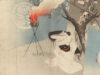
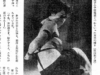
In that sense the photograph was a success, but its background was excessively ordinary and therefore lacked fascination. Its effect would have been several times greater had the setting been a room in a home, a bathroom, a public bath, a school physical-examination room, or even the plain backdrop of a photographic studio, as T. M. has suggested. The photograph itself is certainly welcome, but because the boy’s face is not shown it lacks the finishing touch. In this respect, K. Y.’s proposal in the December issue for “a sequential series of drawings showing a beautiful boy tying a fundoshi” would be more interesting.
T. K. discusses the relationship between Japanese clothing and the fundoshi. He says that a boy wearing a fundoshi should be dressed in Japanese clothing, especially an unlined kimono or yukata. T. K. finds a fundoshi glimpsed between the folds of clothing more stimulating than a completely naked figure wearing nothing but the fundoshi. In such a case, the preferred form is like Isao’s in the October issue: a rokushaku fundoshi incorporating an abdominal wrap and a front apron. It must be evident that this is a fundoshi intended for habitual wear. Otherwise, it may be mistaken for something worn temporarily for swimming. With the rokushaku fundoshi, the idea of continuous everyday use should always be emphasized. A sumō mawashi, of course, is removed when the wrestling is over.
In connection with Japanese clothing, it might also be interesting to depict the body through a transparent or cutaway technique, as in Igūshi’s illustrations for “Newlywed Games.”
The physical sensation of tying a fundoshi on someone, or of having one tied upon oneself, together with the accompanying psychological stimulation, constitutes one of the foundations of fundoshi beauty. Viewed from this standpoint, “pictures of preparation” would also be fascinating: preparation for sumō, preparation for a marathon, preparation for a physical examination, or dressing after a bath. The effect would be still greater were a close female relative, such as a mother or elder sister, present. One might imagine a boy having his mother tie his fundoshi; a boy handing his sumō prize to his sister; a boy who, after completing a marathon, removes his pants and stands in only an athletic supporter while his mother wipes away his sweat; or a mother replacing her son’s etchū fundoshi in the family bathroom. These scenes are desirable to me, although I offer them only as my personal preference.
On the sadistic side of the readers’ responses, the binding and torment of boys in fundoshi has frequently appeared in the readers’ correspondence, and K. Y. also discussed it in the December issue. This differs from ordinary torment because the act of forcing the boy into a fundoshi multiplies the effect of the subsequent torment. Its impact may therefore be expected to be considerable.
H. S. also mentions torment by tattooing, for which a rokushaku fundoshi is, of course, necessary. S. K.’s story “Crocodile Skin” includes a festival scene in which a boy of fifteen or sixteen is about to be forcibly tattooed around the knee. In a story by G. I., a boy named Kozaburō meets a wealthy middle-aged man at a Kamakura bathing beach who claims to be a painter. At the man’s request, the boy appears naked each day and serves as a studio model. I do not possess detailed knowledge of the relationship between seppuku and the fundoshi, but I believe these interests are also connected by closely related factors.
The beauty of boys, and especially the beauty of boys in fundoshi, is a form of feudal, coercive beauty. It is deeply associated with warrior government, militarism, and similar systems. The schoolchildren’s sumō training conducted during the war also expressed this kind of coercive beauty.
In a liberal country such as the United States, children mature rapidly in a relaxed environment and seem to pass almost directly from childhood into adulthood. Boyhood, and therefore the period during which they possess youthful beauty, is extremely brief. T. I. describes this fleeting period with the phrase, “the green luxuriance of an ear of grain that has not yet become sake.”
Having surveyed these tendencies among admirers of fundoshi beauty, I shall offer a conclusion. The greatest common denominator is probably “a picture of a beautiful boy wearing a fundoshi.” As already explained, one must never forget the powerful contribution of background. To make the process clear, dynamic, and memorable, the ideal form would be K. Y.’s proposed “sequential drawings or photographs showing the various ways in which a beautiful boy’s fundoshi is tied.”
Many fundoshi enthusiasts possess a sodomitic inclination, but some pursue fundoshi beauty as a prelude to sodomy, while others experience a stronger attraction to the fundoshi itself than to sodomy. Among them are people entirely detached from sodomy who are devoted solely to fundoshi beauty. After further study of this tendency, fundoshi appreciation should perhaps be established as an independent branch, separate from sodomy.
The End.
Translation Notes
The title uses 褌美愛好家, literally “admirers of fundoshi beauty.” “Bondage enthusiasts” reflects the established English catalog title, but the Japanese term is more specifically concerned with the erotic and aesthetic appreciation of fundoshi. 褌 has generally been retained as “fundoshi,” with specific forms distinguished as rokushaku fundoshi, etchū fundoshi, sumō fundoshi, or mawashi. 締込 refers to the heavy loincloth or mawashi used in sumō. ズック means heavy canvas. 繻子 is satin. 猿股 denotes loose, traditional short drawers, contrasted here with modern パンツ. キャルマタ appears to designate a very abbreviated form of boys' underpants fashionable briefly in the early Shōwa period; the spelling and precise garment remain uncertain. ソドミー is the period loanword “sodomy,” used broadly and without the narrower distinctions common in present-day sexuality terminology. 責め is translated as “torment” rather than “punishment” because it functions as a specialized erotic and SM term. 圧制美 is rendered “coercive beauty,” though “beauty of oppression” would be a more literal alternative. The author repeatedly treats adolescent boys as erotic objects and describes coercive scenarios involving minors; the translation preserves the historical text without endorsing its assumptions. Most correspondents are identified only by initials, and several initials are difficult to distinguish in the scan. The article's substantive text ends on PDF page 61, printed page 68. The remainder of page 61 and all of PDF page 62 belong to the neighboring article “Female Seppuku Found in Kusazōshi Composite Volumes” and have been excluded.
Uncertain readings:
- Several readers' initials are difficult to distinguish because the Latin letters are small and degraded. Readings such as H・S, K・Y, T・M, C・M, G・I, and S・K should be checked against a higher-resolution scan or editorial records.
- The name printed as 土俵四股平 is read provisionally as Dohyō Shikohei; it may be a humorous pseudonym formed from sumō terminology.
- The garment name キャルマタ is transcribed provisionally as kyarumata. Its exact historical spelling, derivation, and construction require specialist confirmation.
- 稲垣足穂's cited collection title appears to read 山風蠱, but the final character and the bibliographic title should be verified.
- The illustrator's name associated with 「新妻遊戯」 appears to read 意遇子, but the scan does not permit a confident identification.
- The phrase attributed to T・I, 「酒とならざる麦の穂の青き豪奢」, is legible in general form, but the precise original wording and whether it is a quotation from another author require verification.
- The cited story title 「鰐の皮」 is the most likely reading, although the first character is slightly degraded.
- The article appears to identify the illustrated boy on the October issue's page 88 as 勇雄, read here as Isao; the personal-name reading is not certain.
Missing or illegible text:
- No complete substantive paragraph is missing, but a small number of initials, pseudonyms, and bibliographic names are not fully legible in the scan.
- A few characters in the reference to Inagaki Taruho's story collection are too degraded for absolute confirmation.
- The transition at the top of PDF page 61 is intact; the article ends in the right-hand columns before the unrelated article begins.