Working in the West, we face a number of problems when trying to understand the history and evolution of kinbaku and Japanese SM culture. Some of those problems are obvious: language, translation, access to sources, and cultural context. But there is a deeper problem that comes before all of these. Much of what Western practitioners have inherited as “kinbaku history” is not simply history in the strict sense. It is a mixture of memoir, magazine culture, erotic self-fashioning, translation, personal loyalty, retrospective storytelling, and later attempts to make rope legible as art.
The Wild West Wasn’t Even the Wild West
In Demolition Man, Sylvester Stallone’s character John Spartan says, “Look! This isn’t the Wild West, okay? The Wild West wasn’t even the Wild West.” We face a similar dilemma with kinbaku. The history many of us received in the West was already a story about a story: a version of Japanese rope filtered through magazines, memoirs, charismatic teachers, translations, and the desire to give kinbaku a respectable cultural lineage. The problem is not that this history is simply false. The problem is that its sources are not neutral. They are often valuable, even indispensable, but they have to be read as stories people told about the past, not as the past itself.
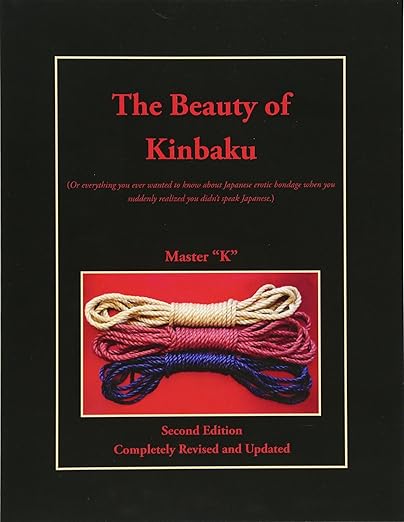
This realization came to me late, and personally. My first serious education in kinbaku history came through Master K and The Beauty of Kinbaku, a book that helped shape how many Western practitioners understood Japanese rope as art, culture, lineage, and history. I was close to that project. I studied with Master K, worked with him for years, contributed photography to the second edition, and photographed the Japanese translation. That proximity matters because this essay is not written from outside that history. It is written from within it, from the position of someone who inherited one story about kinbaku and then had to learn how to read that story more critically.
What changed for me was not simply my opinion of one book, one teacher, or one symposium. What changed was my understanding of what counts as evidence. A magazine page from 1953, a later memoir by Nureki Chimuo, a recollection by Toshiyuki Suma, and an English-language synthesis written decades later are not the same kind of source. They may all be useful, but they cannot be collapsed into a single smooth origin story. If we want a better history of kinbaku, we have to look not only at masters, techniques, and lineages, but at magazines, captions, reader letters, advertisements, editorial frames, legal pressures, and the larger postwar SM culture in which rope was only one thread.
That is the argument I want to make here: kinbaku history should not be stripped of its romance, but we need to understand how that romance was made.
My Education in Kinbaku History
I started studying kinbaku in 2006, and my first teacher was Master K, author of The Beauty of Kinbaku, often cited as the definitive English-language history of kinbaku. I was his student for eight years, assisted with classes, private lessons, photo shoots, and film productions, contributed photographs to the second edition, and photographed the Japanese translation of the book. We also exhibited together in 2013 at Shinjukuza Gallery in Tokyo.
I mention this not to claim neutrality, but to make clear that my education in kinbaku history came from inside that world. In retrospect, I think the power of The Beauty of Kinbaku came from its act of elevation. It gave Western practitioners a way to understand rope not simply as erotic practice, but as art, culture, lineage, and history. That was valuable, but it also shaped what kinds of evidence seemed important and what kinds of origins seemed desirable.
When the Japanese translation was released, I accompanied Master K to Tokyo and Kyoto for the book tour and saw how it was received. What struck me was the surprise that someone from the West was treating kinbaku, often dismissed as pornographic or hentai, as a serious Japanese art. At the time, the book was well received.
At the time, I wanted that art-historical framing to be true, not only because it elevated kinbaku, but because it elevated the work I was doing inside it.
The Kyoto Symposium and Kawahara’s Critique
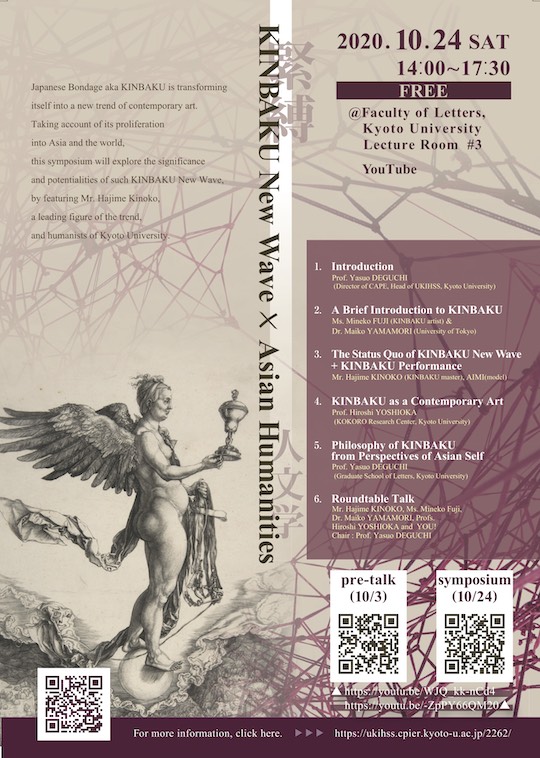
Things began to shift in October of 2020 after Kyoto University hosted a symposium titled “New Wave Kinbaku X Asian Humanities.” The symposium featured four Japanese scholars presenting papers on kinbaku and a performance by Hajime Kinoko, followed by a roundtable discussion with both the academics and professionals.
One of the attendees of the symposium was an academic researcher named Azumi Kawahara from Fukuoka Women’s University who has published extensively on SM culture, early SM publications, and her book SMの思想史 (A History of SM Thought) which details the evolution of SM and erotic desire in postwar Japan.
In a very extensive and detailed series of posts, she documented two very serious critiques of the symposium. The first a criticism of the academic rigor of the presentations, which undermined the credibility of the arguments that were presented. The second, which was far more serious, was an accusation of academic plagiarism.
Much of the presentation of at least one presenter was copied, nearly verbatim, from Master K’s book, The Beauty of Kinbaku. It was repeated without citation and without acknowledgement.
What Kawahara’s accusation unveiled was not just an act of academic dishonesty, but an act of intellectual carelessness as well. The issue was not only that The Beauty of Kinbaku had been plagiarized, but that it had been treated as a primary historical authority in a context where its status required much more caution.
I am not primarily interested here in adjudicating the plagiarism charge itself. What matters for my argument is what the controversy exposed: The Beauty of Kinbaku had come to function as historical authority in contexts where its source status needed more scrutiny.
As she pointed out, Master K’s book was self-published and not a product of academic peer review. As a book written for a general audience, that was fine, but to be used as a primary historical reference was academically suspect.
At this point, Nawashi Kanna and Kagura, a well-known couple who practice kinbaku at the highest professional level, entered the conversation.
Kanna and Kagura agreed with the concern, arguing that Master K “did not have enough background understanding of Japanese society and culture in general” and warning that The Beauty of Kinbaku had become a foreign “textbook” despite containing “biased information and misconception.”
Together, their critiques forced me to ask what kind of authority The Beauty of Kinbaku had come to hold.
What I Had Missed
I understood why The Beauty of Kinbaku had taken the shape it did: Master K wanted to present Japanese rope as an aesthetic and historical subject, elevating it above its erotic origins.
The book made that argument compellingly, but Kawahara, Kanna, and Kagura helped me see what that argument left out.
Japanese SM cannot be understood only through art. It also has to be understood through perversion, abnormality, fantasy, commerce, censorship, and sexual desire.
I realized there was a stark contrast when, in 2014, I hosted Akira Naka along with Master K. During an interview after his performance with Iroha san, Master K asked Naka san about how he felt about being an artist.
Naka san’s expression changed immediately and he eschewed any claims to artistic pretension. He told Master K in response, “I’m not an artist, I’m a pervert.”
The answer landed awkwardly because it refused the very frame the question offered.
During lunch after the event, I asked Master K about it and I found his response telling. He told me that Naka san hadn’t understood the question and if he had, he would have answered quite differently.
Over the years, as I have gotten to know Naka san, I can say without hesitation that I do not think he misunderstood the question at all.
Recently, I have had the opportunity to correspond with Kawahara san and learn more about her research. Her book delves deeply into the history of Kitan Club and early SM magazine culture. I shared my background and history with her and touched upon mutual interests.
To my absolute dismay, she wrote to me to say she was “not a researcher of kinbaku” so her understanding was limited.
It was a moment of what I can only consider cognitive dissonance. For me, given my training and background, Kitan Club was a magazine about kinbaku! How was it possible that she could have written a book about Kitan Club and not be an expert on kinbaku?
Her answer forced me to realize that I had been treating kinbaku as the center of the archive, while she was seeing it as one object within a much larger history of postwar SM desire.
The point became clearer when I began reading magazines such as Kitan Club, Fūzoku Sōshi, and Uramado themselves rather than only later accounts of them. Rope was there, but it sat beside fiction, confessions, illustrations, reader letters, medicalized explanations, advertisements, and arguments about what counted as SM rather than mere brutality.
This brings me back to the question at the center of Kawahara’s critique: what counts as the history of kinbaku?
Kawahara makes a compelling case that because kinbaku and SM have never been studied as true historical artifacts, what passes for history is mainly recollection, anecdote, and storytelling. And while those things are not without charm, they are also not historical documentation.
Nureki and the Problem of Memory
Chief among those reflections are the works of Nureki Chimuo, who documented his personal history in writing ranging from blog posts to books, that describe, and oftentimes elevate, key figures in the history of kinbaku.
This is the kind of historical naiveté that Kawahara warns against, and it is a danger that shaped much of the earlier English-language reception of kinbaku history. Kawahara sees Nureki, for example, as an indispensable but dangerous source: indispensable because his writings preserve otherwise inaccessible knowledge about postwar SM magazine culture, but dangerous because his accounts are shaped by literary craft, memory, loyalty, inference, and retrospective storytelling. His work should not be discarded, but it must be read critically as both testimony and narrative construction.
Kawahara’s warning is not that Nureki, Toshiyuki Suma, or other early participants should be ignored. Rather, it is that their accounts became persuasive because they were written as stories. They preserve names, scenes, and memories, but they also arrange those memories into coherent narratives after the fact. This is what makes them useful and dangerous at the same time.
This is precisely the kind of evidence that earlier English-language kinbaku histories often treated too confidently.
Toward a Better Kinbaku History
A better history of kinbaku will not discard the old stories. It cannot. Figures like Nureki remain indispensable because they preserve memories, names, and scenes that might otherwise disappear entirely. But preservation is not the same as documentation, and a compelling narrator is not the same as a reliable witness. The stories must be read as stories: shaped by loyalty, desire, rivalry, editorial pressure, and the pleasures of retrospective narration.
What Kawahara’s work makes possible, and what the Kyoto symposium’s failure illustrated, is a different kind of attention. Not the attention we pay to masters and lineages, but the attention we pay to magazines, reader letters, captions, advertisements, censorship battles, and the slow negotiation over what SM was allowed to mean in postwar Japan. Rope appears in that archive, but it does not dominate it. It sits alongside fiction, confession, illustration, and argument, one thread among many, waiting to be read in context rather than extracted as origin.
I spent years inside a story that made kinbaku legible as art, as lineage, as cultural inheritance worth taking seriously. I still think that project had value. But I also think Akira Naka understood the question perfectly. He simply refused to answer it on terms that weren’t his own. That refusal, to the framework of elevation, the aesthetic alibi, the respectable origin, is maybe the most historically honest thing anyone said in the room that day.
Kinbaku history depends on what we are willing to count as evidence. It also depends on what we are willing to count as kinbaku.