Over the past decade, a renewed debate has emerged about the origins of kinbaku (Japanese erotic rope bondage). At the center of that debate is the relationship between kinbaku and hojojutsu, the older Japanese arts of capture and restraint. The question is deceptively simple: did modern erotic rope bondage develop out of hojojutsu, or has that connection been overstated?
Different writers and practitioners have answered that question in very different ways. Some have emphasized continuity, arguing that Japanese rope bondage draws from a much older history of battlefield restraint, policing techniques, Edo-period punishment, and formalized capture or arresting rope. In this view, modern kinbaku inherits at least part of its technical vocabulary from hojojutsu, even if its purpose and context have changed dramatically. This general position was popularized in English by Master K’s The Beauty of Kinbaku, though the claim was considerably softened in the Japanese translation. A related version of the claim also appears in Midori’s The Seductive Art of Japanese Bondage, although Midori has substantially revised her own account since that book’s publication in 2002.
Others have pushed back against this genealogy, arguing that the hojojutsu connection has often been inflated into a legitimizing origin story. From this perspective, claims of direct continuity risk obscuring the modern, erotic, theatrical, commercial, and subcultural contexts in which kinbaku actually developed. These critics are right to be wary of stories that make kinbaku seem older, purer, or more traditionally Japanese than the historical evidence can support.
Much of the disagreement depends on what we mean by origin and what we mean by kinbaku. If we are asking whether modern kinbaku descends directly from hojojutsu as an unbroken martial or policing tradition, the answer is almost certainly no. If, however, we are asking whether older capture-rope techniques, images, manuals, and fantasies were taken up by postwar erotic writers and bakushi, then the answer is more complicated.
Hojojutsu is not the origin of modern kinbaku in any simple genealogical sense. It did not evolve directly into shibari as a continuous tradition of technique, ethics, or aesthetics. But neither is the connection purely mythical. In postwar erotic print culture, older capture-rope techniques became available as images, references, manuals, fantasies, and bodily experiments. Kinbaku emerges not from the preservation of hojojutsu, but from its erotic recontextualization: a transformation of restraint into pleasure, policing into fantasy, and capture into aesthetic display.
The Erotic Context of Rope
Like any social practice, and particularly any underground social practice, origins are always messy, complicated, multiple, and deeply human. This is a point Midori makes in her later essay historicizing modern kinbaku (“The History & Myths of Japanese Bondage: Censorship, Sex Work, and Othering in the World of Shibari“). Similarly, Ugo makes a compelling case for theater as a profound influence on the development of contemporary rope bondage in Japan, much more than hojojutsu.
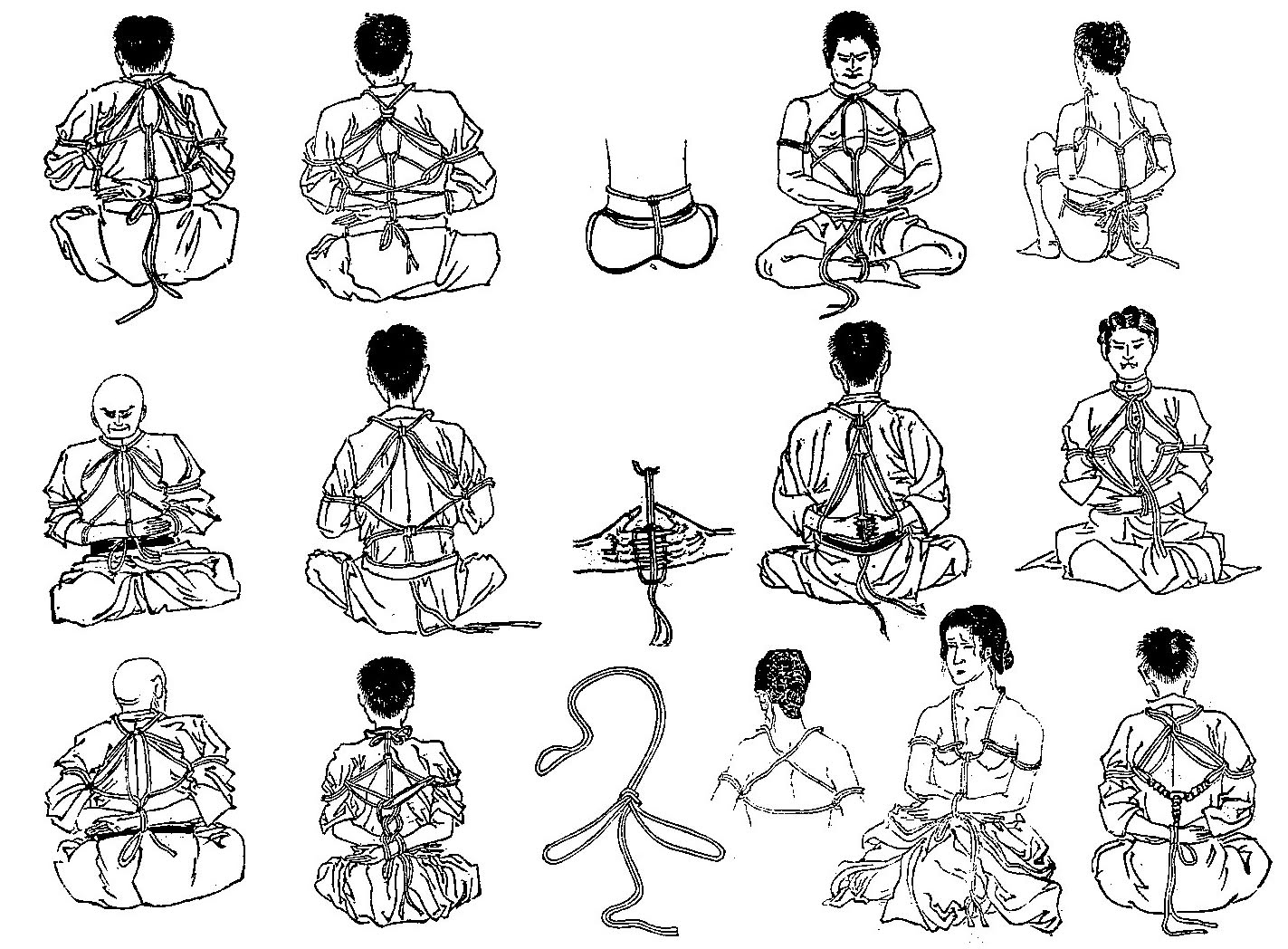
If we strip the erotic context from kinbaku and focus solely on techniques, we can identify knots and forms that have persisted across time. In fact, books that document various ties and schools of hojojutsu became research material for many of the most famous Showa-era bakushi and it was common to integrate techniques from those manuals into new ties and patterns. More than a few articles in magazines like Kitan Club include documentation of various hojojutsu ties and descriptions of how to tie them.
But ignoring the erotic context in which these bakushi were operating would be the equivalent of claiming Western bondage has its origins in 1862 when W.V.A. Adams patented the first adjustable ratchet-style handcuff, which allowed the device to fit different wrist sizes. It is, indeed, a kind of origin, but not an especially interesting or revealing one.
One of the things that makes kinbaku unique and interesting is the erotic context from which it emerged (including the changes in cultures of eroticism of the Meiji Restoration).
So what is the connection between these old martial and policing techniques and modern-day erotic rope bondage?
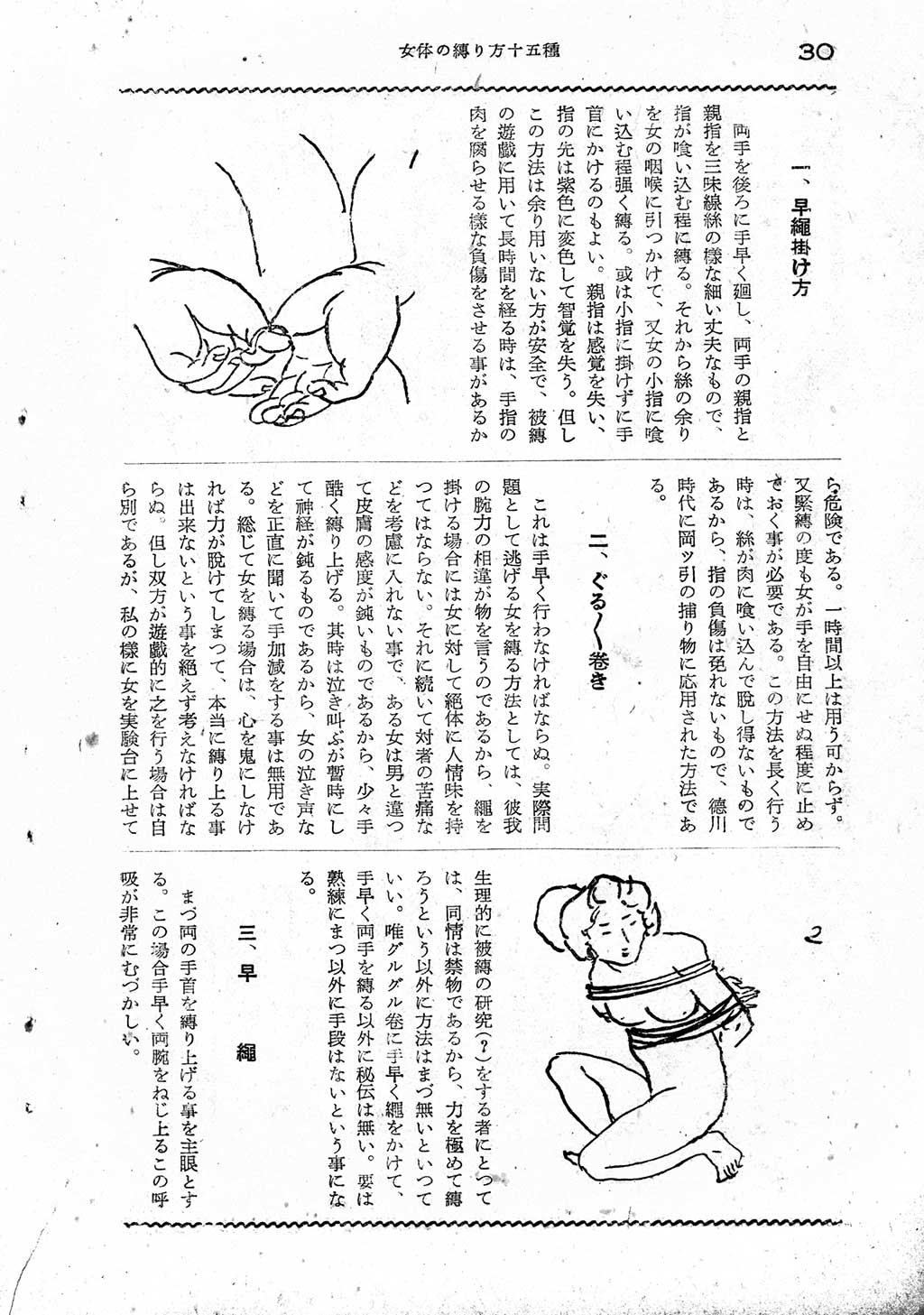
The link between the two only makes sense if we put the eroticism first. There is a strong case to be made that at least some of those engaged in early postwar SM and kinbaku discourse were aware of hojojutsu. There is even some evidence that Itoh Seiu learned rope policing techniques very early, as documented in Yako Saito’s “Legend of Seiu Ito” (Toyoshima Shobo, 1966). The best understanding of Itoh’s relationship, however, comes from his 1953 Fuzoku Soshi article “Fifteen Ways of Binding the Female Body.”
The question he raises is how these older policing techniques, primarily designed for the male body, could be adapted to tying the female form. Itoh expresses the intention clearly when he writes: “The first aim ought to be to restrain her freedom while making her body appear pleasing, or to wound her and savor her expressions of pain, or else to do it for amusement or perverse pleasure. There are many differences of degree.”
Itoh’s transformation is not one of technique or style, it is one of purpose.
Similarly Takeshi Shuichi’s 1953 essay in Kitan Club “Miscellaneous Notes on Capturing-Rope” positions hojojutsu in the erotic contexts of gay male desire and self-bondage, when he writes: “As I have written before, being tied up by someone of the same sex is something I like very much, but of course there are rarely any good opportunities for that. So I naturally came to enjoy looking at pictures of captured criminals and, above all, amusing myself by trying to tie myself up.”
Shuichi is not talking about Edo-era torture ties, but is making clear reference to the rope used in policing and prisoner restraint, remarking in the distinction among rank and class, “the Edo-period samurai, commoners, and the social ranks beneath them differed in the way they were tied . . . [these] ancient forms seem to be largely things reserved for special police or arresting officials.”
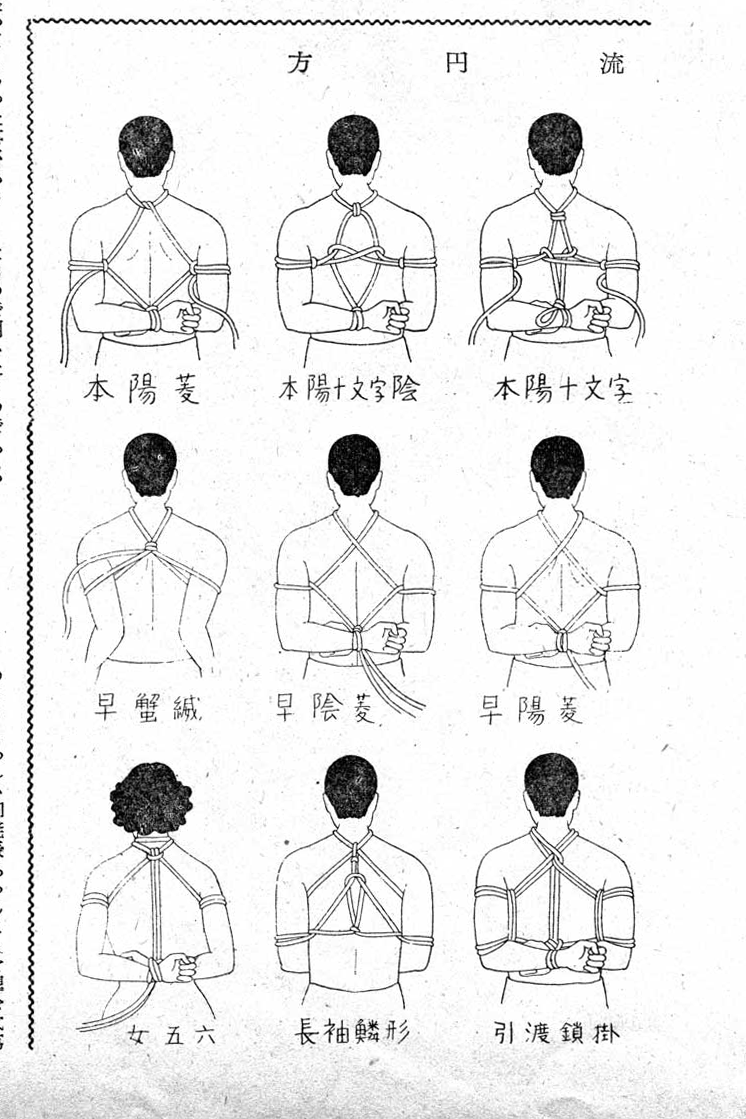
The purpose of these ties, which are documented with drawings and described in detail, is neither historical preservation nor purely for restraint. Instead, the purpose is a form of erotic pleasure. “If one tries to do anything,” Shuichi writes, “the shape becomes extremely painful, and one’s body seems to reach a state of exquisite sensation in about twenty minutes. This is more painful than being bound by someone else, but also very pleasant.”
Over the next few decades numerous other bakushi would adopt the same approach. From Nureki Chimuo and Akechi Denki to Miura Takumi, who had a deep and abiding commitment to the history and tradition of older rope techniques, it was commonplace to study and adapt hojojutsu ties for erotic purposes.
Yet this erotic reclassification did not produce a single attitude toward hojojutsu. For some writers, capture rope provided fantasy material. For others, especially those concerned with kinbaku-bi, hojojutsu marked precisely what modern erotic rope had to move beyond.
The Aesthetic Context of Rope: Hojojutsu and Kinbaku-bi
One influential account of rope-bondage aesthetics, associated especially with Osaka and Takashi Tsujimura’s work in Kitan Club, marks the cleanest break between capture rope and the emergence of kinbaku-bi, or “beautiful bondage.”
In a 1953 article, Takashi Tsujimura, writing about tying the takate kote distinguished between hojojutsu and kinbaku based on aesthetics. He wrote: “Various methods for applying hojonawa (capture rope) have been left behind in writing, but since these make the prevention of escape their primary object, even if they may be useful as reference, it is only natural that they differ from tying methods whose purpose is the pursuit of the aesthetic beauty of kinbaku.”
Taking aesthetic beauty as a purpose reframes the relationship with older techniques and styles of bondage. While hojojutsu was intended to have a sense of beauty to it (one of the four rules, according to Richard Cleaver, 1998), the primary function was restraint. In hojojutsu, beauty largely resides in the order, pattern, and discipline of the rope. In kinbaku-bi, beauty is relocated to the bound human form. That disjunct is enough, at least for Tsujimura, to sever the connection between the two.
Tsujimura contends that “when binding a person, it has since olden times been almost a fixed rule to bind them with the hands behind the back, and from the standpoint of capture rope that is of course only natural. But when the purpose is the pursuit of the beauty of the female body through kinbaku, one wonders whether that is really sufficient.”
While Shuichi found the aesthetics of hojojutsu to be an element of male erotic fantasy, Tsujimura did not find the connection especially compelling for the development of kinbaku-bi.
While acknowledging hojojutsu historically, for Tsujimura, the aesthetic considerations make it unsuitable as an avenue to pursue for kinbaku-bi. He continues: “In other words, methods that go so far as to destroy even the beauty of the body’s lines by binding in a reckless, haphazard way will be set aside here.”
The Perversion of Hojojutsu
The best word for this transformation may be hentai seiyoku, or perhaps the broader logic of hentai: perversion, abnormality, and transformation. According to Mark McLelland, the term hentai seiyoku or “perverse or abnormal sexual desire” was popularized via the 1894 translation of German sexologist Krafft-Ebing’s text Psychopathia Sexualis which was given the Japanese title Hentai Seiyoku Shinrigaku (The psychology of perverse sexual desires). As Japanese sexual discourse changed across the Meiji and post-Meiji periods, older images of punishment, restraint, exposure, and bodily suffering could be reinterpreted through new forms of erotic classification and fantasy. The term did not simply describe acts; it helped produce desire as something that could be classified, named, diagnosed, circulated, and eventually inhabited.
This matters for kinbaku because it helps explain how older forms of restraint could become erotic without becoming a continuous tradition. Hojojutsu did not need to be preserved as a martial or policing art in order to influence kinbaku. It could be reclassified. Its images, techniques, postures, and narratives of capture could be detached from their original function and reorganized as fantasy.
In that sense, “perversion” should be understood literally: a turning or bending of purpose, a transformation or metamorphosis. Hojojutsu was designed to capture, restrain, display authority, and prevent escape. In the hands of postwar erotic writers and bakushi, those same elements could be redirected toward pleasure, shame, pain, anticipation, beauty, self-recognition, and theatrical display. Rope did not pass unchanged from policing into eroticism. It changed state and in doing so, became something new.
Itoh Seiu’s question about how older restraint techniques could be adapted to the female body is one example of this transformation. Takeshi Shuichi’s fascination with captured-criminal imagery, same-sex binding, and self-bondage is another. Tsujimura’s kinbaku-bi represents yet another turn, one in which capture-rope techniques become insufficient precisely because they fail to foreground the beauty of the bound body. In each case, the historical importance of hojojutsu lies not in continuity but in erotic recontextualization.
This is why both the continuity argument and the skeptical response remain incomplete. Hojojutsu is not the origin of kinbaku in the sense of a stable lineage. But neither is it irrelevant. It became one of the materials through which modern Japanese rope eroticism imagined itself. Kinbaku did not preserve hojojutsu. It perverted it.
Neither Origin Nor Myth
In the end, it is difficult to sustain the claim that hojojutsu is the origin of modern kinbaku in any direct or continuous sense. The skeptics of that genealogy are right to challenge stories that make kinbaku appear older, purer, or more traditionally Japanese than the evidence allows. But postwar writers and bakushi also clearly encountered older capture-rope techniques as images, manuals, historical references, and fantasy material.
The more accurate claim is that hojojutsu was one influence among many: not a stable lineage, but a touchstone. Its importance lies less in preservation than in transformation. Kinbaku did not simply inherit hojojutsu. It reclassified it, eroticized it, aestheticized it, and turned capture into pleasure, restraint into display, and technique into erotic imagination.
References
Cleaver, R. (1998). On hojojutsu: Translations from the 1964 works of Headmaster Nawa Yumio.
Itoh, S. (1953). Fifteen ways of binding the female body. Fuzoku Soshi.
Master “K.” (2014). The Beauty of Kinbaku: Or everything you ever wanted to know about Japanese erotic bondage when you suddenly realized you didn’t speak Japanese (2nd ed.). King Cat Ink.
McLelland, M. (2005, July). A short history of “hentai”. Paper presented at Sexualities, Genders and Rights in Asia: 1st International Conference of Asian Queer Studies, Bangkok, Thailand. AsiaPacifiQueer Network, Mahidol University; Australian National University.
Midori. (2002). The Seductive Art of Japanese Bondage. Greenery Press.
Midori. (n.d.). The History & Myths of Japanese Bondage: Censorship, sex work, and othering in the world of shibari. Spectrum Boutique.
Saito, Y. (1966). Legend of Seiu Ito. Toyoshima Shobo.
Shuichi, T. (1953). Miscellaneous notes on capturing-rope. Kitan Club.
Tsujimura, T. (1953). Gote and Takate Kote. Kitan Club.
Ugo, interview in Darkly_Dreaming. (2020, December 20). Kinbaku – An evolving era – Part 2. Kinbaku Today.