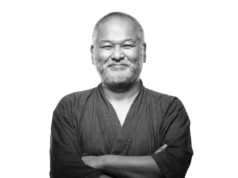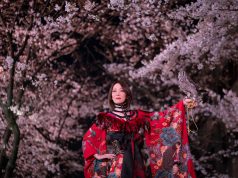
Kasumi Hourai is unquestionably the world’s leading female kinbaku artist, with a unique style based on growing up immersed in an environment of cultural Japanese philosophy and practises.
Few have incorporated this so completely into their work. Nureki Chimou as a teenager was briefly in a kabuki troupe, Ryoko Tachibana, who retired in the 1980s had tea ceremony and ikebana flower arranging teaching licenses, and currently Fuu of Bar Mitsu plays biwa with his kinbaku.
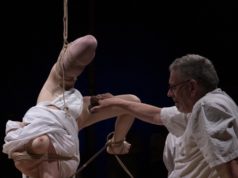
I first met Kasumi in 2012 when she performed in Akira Naka’s old traditional house in Roppongi. Nao Nagasawa, her model that day, dressed as a noblewoman in fine kimono knelt at a kyoudai dressing table, looking shameful. Kasumi appeared as a servant, invited by Nao to punish her with kinbaku.
I’ve seen dozens of performances in Japan. This one still haunts, and inspired me to understand what I witnessed. The diversity of our cultures always results in words untranslatable. So, the challenge is to do the best we can in explaining in ways the reader can understand.
Sin: Kasumi–san, thank you for agreeing to this in–depth interview. You initially felt it would be too difficult to convey key nuances to Western readers. But now we are fortunate to have the services of Mie, an expert translator and Japanese SM scene guide who we trust will clarify your sentiments correctly.
I’d like to start from the beginning. Could you tell us about your childhood, and how you became involved with SM? Did you ever tie yourself, dolls or friends when you were growing up?
Kasumi: Yes, I did. More than 40 years ago, I happened to see a fetish magazine and discovered the world of kinbaku. Out of curiosity, I tried lightly tying up friends, dolls, and myself a few times with string or a handkerchief. However, I was still a child at the time, so I did not yet see it as sexual play. I thought of it as a secret game that adults shouldn’t know about.
Sin: How did you learn about kinbaku?
Kasumi: As a child, I only tied people up for fun, but little by little my interest grew. By the time I was in middle school, I was already buying DVDs with kinbaku scenes and watching them over and over.
When I was 15, I started using a ‘Tere–Kura’ phone club, I met people with similar interests and gradually started learning to tie people. I also learned by being tied. At first, I learned kinbaku completely through trial and error, as an amateur enthusiast. By then I was totally in love with kinbaku.
Shibari is a sexual act according to Japanese law, so it’s prohibited prior to the age of 18. However, when I was young, restrictions in Japan on sexual matters were very lax, and even minors could easily engage in this kind of activity.
(Note: A ‘phone club’ was a system created in the 1980s in which phone numbers were assigned to specific fetishes, and you could call them to find someone with the same fetish and make an appointment to meet up. This was the main way for kinksters to find each other in the end of the Showa era, prior to the invention of online chat rooms)
Sin: How did kinbaku become your profession?
Kasumi: The psychological factors that influenced my decision are the most important to explain how I decided to become a professional, so I’ll begin by talking about my upbringing.
Growing up, my biological parents’ home was extremely poor, with a violent father and a mother who was indifferent to her children. We lived in extreme poverty. One day, I was seriously injured in a domestic violence incident and was taken into foster care. After a complicated process, I was adopted into a relatively wealthy family.
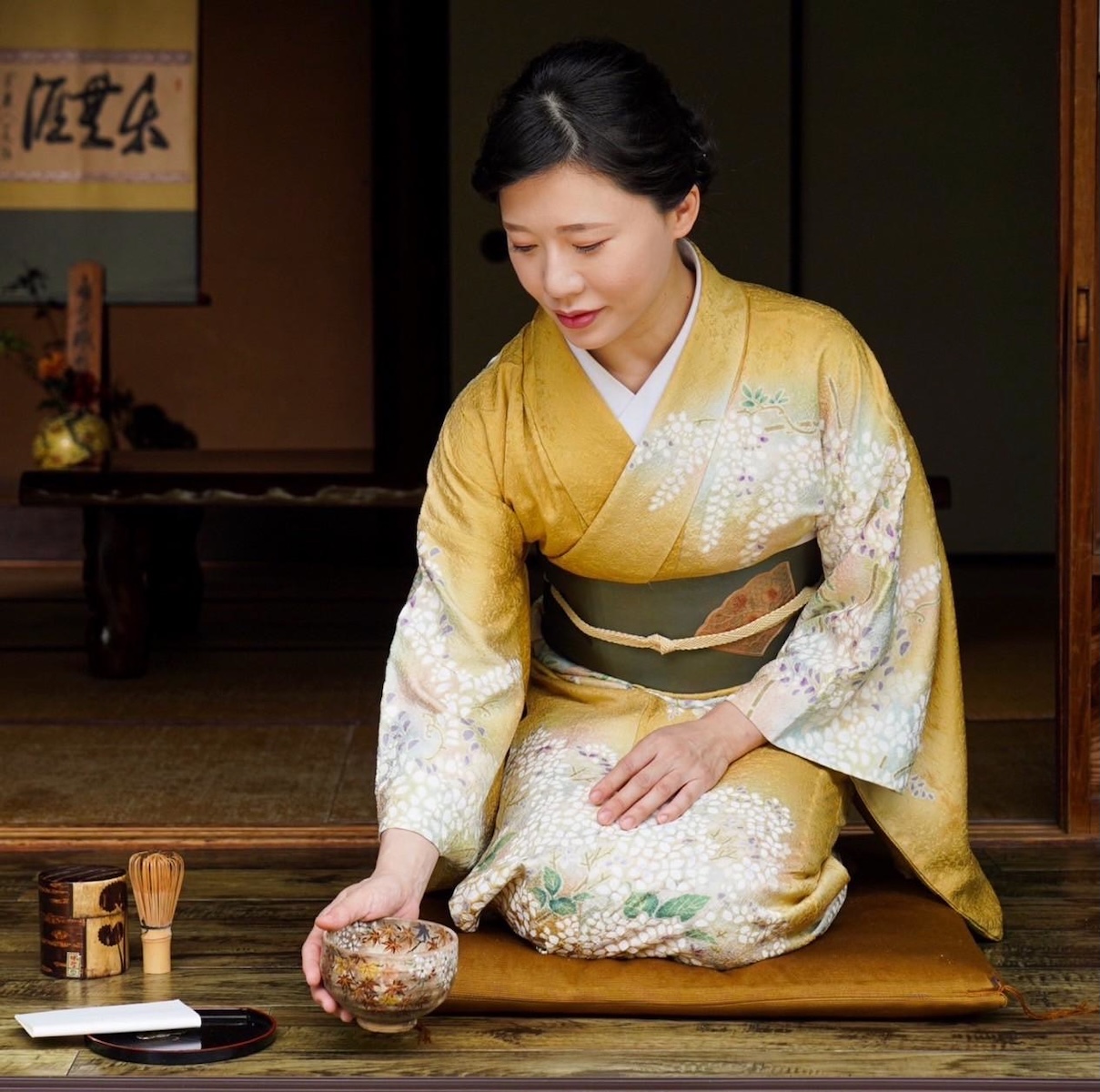
This family was a strict and traditional family that taught tea ceremony and flower arranging, or ikebana to students. Being in such an unusual home, one that taught Japanese culture, I was under pressure every day and I lived both in a constant state of neglect and as if I was holding my breath.
Contrary to the outward appearance that my adoptive family was cultured, elegant, and refined, a traditional home that taught tea ceremony and flower arranging, behind the scenes it was a home bound by outdated ideas. This included strict discrimination, as I was not their biological child, and fierce condemnation of other houses that taught competing schools of tea ceremony and flower arranging. Witnessing all of this with my own eyes, and from listening to my adoptive my parents, I grew up seeing the complex, conflicting sides of people, both their beautiful and ugly sides.
In a traditional household, you can’t go against what your parents say. Individuality and opinions aren’t welcomed. So, I asked myself every day, “What am I living for?” Though living with my biological and adoptive families caused me different types of pain and put me under a great deal of stress, I survived at home by suppressing my emotions. However, during my rebellious phase, I finally reached my limit.
I made a firm resolution: ‘I’ve already endured about three times the amount of pain in a normal person’s life in the first 15 years of my life. I’m not going to put up with anything anymore.’
The first time I said no to my stepmother was on my 18th birthday. I told her I wouldn’t go to college and would do what I wanted with my life. The day after I graduated from high school and turned 18, I rebelled against my adoptive mother for the first time in my life and went to an interview at an S&M club of my own volition.
I figured that working at an S&M club would allow me to perform a lot of kinbaku every day.
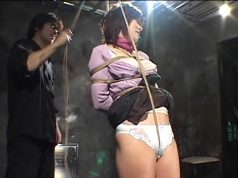
However, in reality, kinbaku makes up less than 10% of what occurs at SM clubs in Japan; what’s actually provided are sex services, costumes, and SM using tools other than ropes. So, I quit after about two years. After that, I started my own business so I could focus on kinbaku (I registered my business with the police and operated it myself, tying up customers), which led to my first visit to see a professional kinbaku artist, the late Akechi Denki.
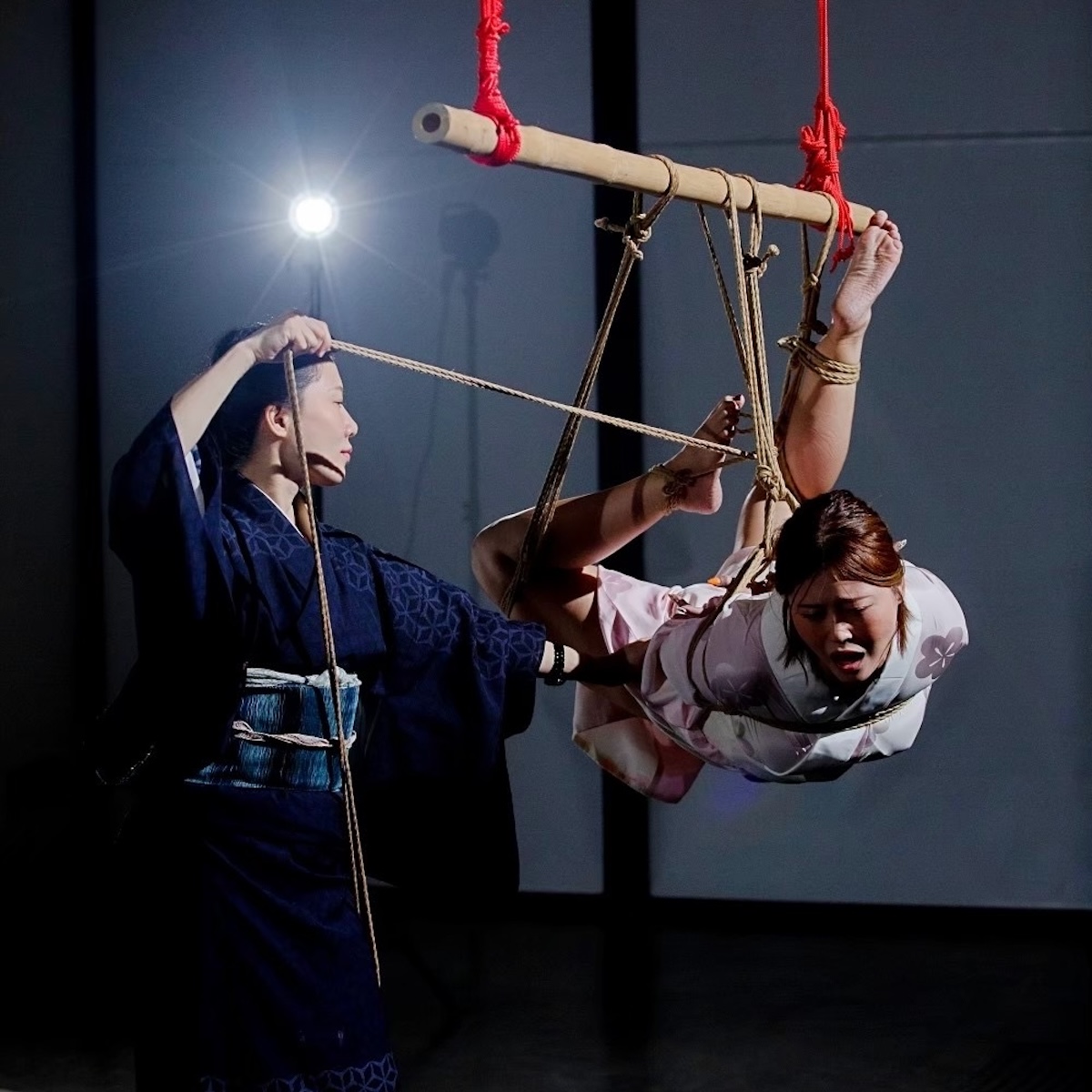
Sin: You’ve learned from many great kinbaku artists. Who was the person who influenced you the most, and how?
Kasumi: There are two people who have influenced me: one technically and the other spiritually, so I’ll talk about them both.
The person who has had the greatest influence on me technically is Naka Akira–sensei.
Naka–sensei’s rope techniques are that of a genius and simply impossible to imitate. People often say that only Naka–sensei can do the Naka style, and I absolutely agree. Even if you can imitate the rope techniques, the exquisite aesthetic appearance and strength that is embodied in his rope work creates an object of perfect beauty, and I feel it is the epitome of Japanese aesthetic sense. I feel that it is the perfection of soulful rope bondage that others cannot achieve no matter how hard they try.
I was fascinated by Naka–sensei’s beautiful kinbaku with its Japanese–style design. From the first time I met Naka–sensei to this day, my image of him has not changed: he is a genius blessed with talent and loved by rope. He had a huge impact on me, and I learned so much from the time we worked together. I took part in his private lessons, was his performance model, and even his apprentice for a while.
The person who had the greatest influence on me mentally was undoubtedly the late Akechi Denki–sensei.
Akechi–sensei was not the type to teach kinbaku techniques from start to finish, with steps from 1 to 10. Though it is true that Classical Kinbaku does have a set foundation chest harness (TK) that all subsequent ties are built on, Classical Kinbaku uses leftover rope to decorate or tie things according to inspiration at that moment in time. So, the finished product is different each time. Unlike Modern Kinbaku, which could be thought of as a more logical kinbaku with manuals and high reproducibility, there are many aspects of Classical Kinbaku that cannot be explained in words. Though it was impossible to learn and perfectly reproduce his unique techniques, we talked a lot about ropes and he was the first professional kinbaku artist who tied me for the first time when I was 20 years old.
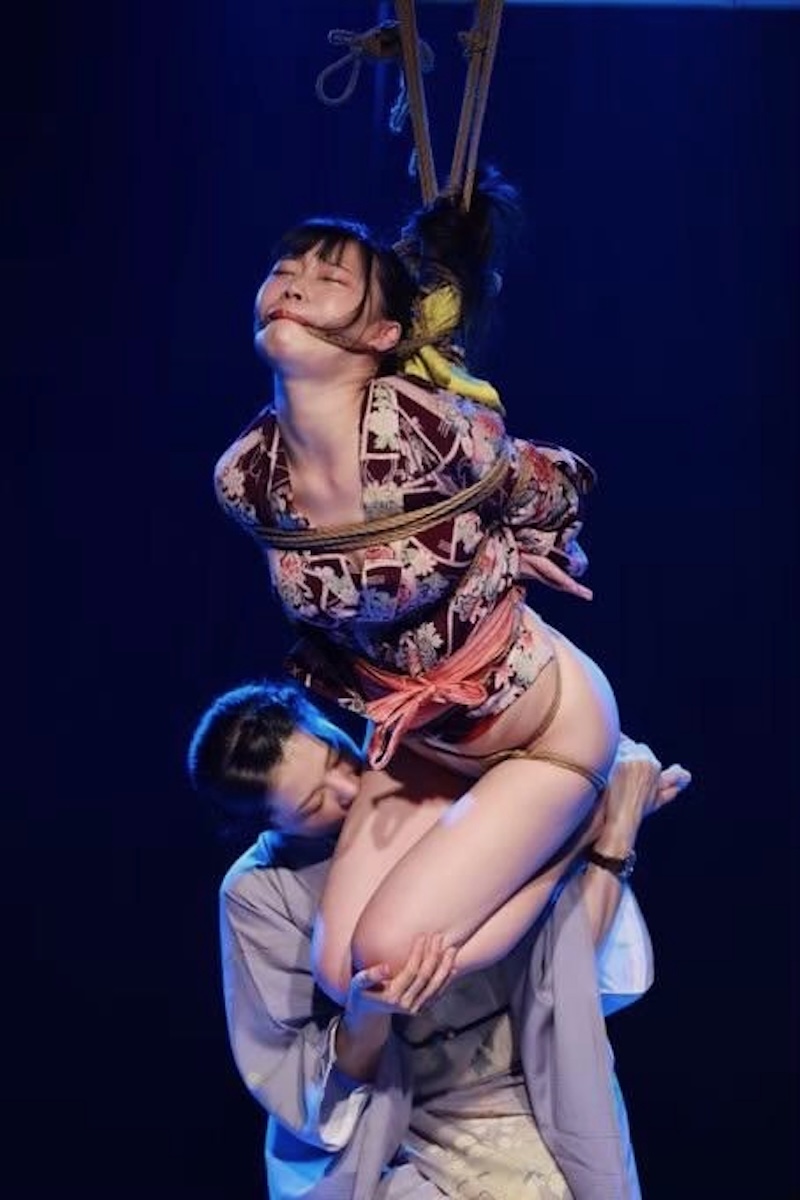
Finally, Akechi–sensei taught me something more valuable than technique. That is the sense of happiness that comes from tying, and the importance of the spiritual maturity of the person tying. When we think of the importance of professional artists, their technical skill is a given, what sets them apart is their artistic sense. So, when a famous kinbaku artist retires or passes away, it’s not just their skill that is talked about. We tell anecdotes and talk about the late artist’s personality, such as what kind of person they were and how we interacted with the artist during their lifetime. I have so many stories about Akechi–sensei that I can’t even begin to describe them all in this interview, so if you’re interested, please ask me. They’re all wonderful stories.
Akechi–sensei never belittled or criticised people who are less skilled at rope work than he was. He was the kind of person who would never speak ill of younger kinbaku artists or do anything to get in their way. He was truly a man who had a wonderfully developed character as a rope artist. I believe this is why Akechi–sensei is so beloved not only for his kinbaku techniques but also for his personality, and I admire and respect him very much.
Like Akechi–sensei, I never belittle my fellow or younger kinbaku artists. It is in this spirit that Akechi–sensei has influenced me. Whenever I feel like my weaker feelings are about to get the best of me, I remember Akechi–sensei’s face and try to straighten myself out. This is as important as, if not more important than technique, and I feel that Akechi–sensei had a great influence on me psychologically.
Sin: What do you think is the difference between the words “shibari” and “kinbaku”?
Mie: Note: these two terms are linguistically linked. Kinbaku is made up of two Chinese characters; ‘tense’ and ‘tie.’ Shibari is another way of pronouncing the second character, ‘tie.’
Kasumi: I’ve never thought about the difference between these two terms. I don’t feel it’s important to define the terms precisely, so I don’t differentiate them clearly, but I thought about it anyway.
‘Shibari’ or ‘I tie’: It doesn’t matter if the rope is loose, tight, or artistic. It gives the impression of a casual style of tying that isn’t particularly passionate.
‘I will do kinbaku’: Not loose, but tight and firm. It gives the impression of tying that involves focusing very hard on the other person’s mental state, and putting in a strong, purposeful effort to connect deeply with them spiritually.
This is the image I have, but in reality, I don’t distinguish between the two terms. I’m often asked this question by Westerners. It’s interesting because I never get asked this question from Japanese people. Is it a difference between Japan and the West in whether or not we clearly define terms in general? This was a very new and interesting question, so I decided to consider the difference for the first time.
Sin: How challenging is it to teach Westerners about the Japanese cultural aspects of kinbaku?
Kasumi: This is a question that’s so difficult to put into words that I’d like to resort to the popular CHAT GPT. I think what you all want to hear are ‘Hourai Kasumi’s personal thoughts,’ so I’ll answer based on my own thoughts without the aid of the latest technology, lol.
Japanese culture in Kinbaku… in order to understand how difficult it is to teach this to Westerners, I’ll first make an important preface: I want you to understand the uniquely Japanese way of thinking about ‘words’, which differs from Western thinking.
For example, taking ‘wabi–sabi’ as an example, we Japanese take it for granted that it’s impossible to explain in detail what this word means. We believe that these particular words are not something that need to be explained, but something that each person perceives for themselves through their life experiences.
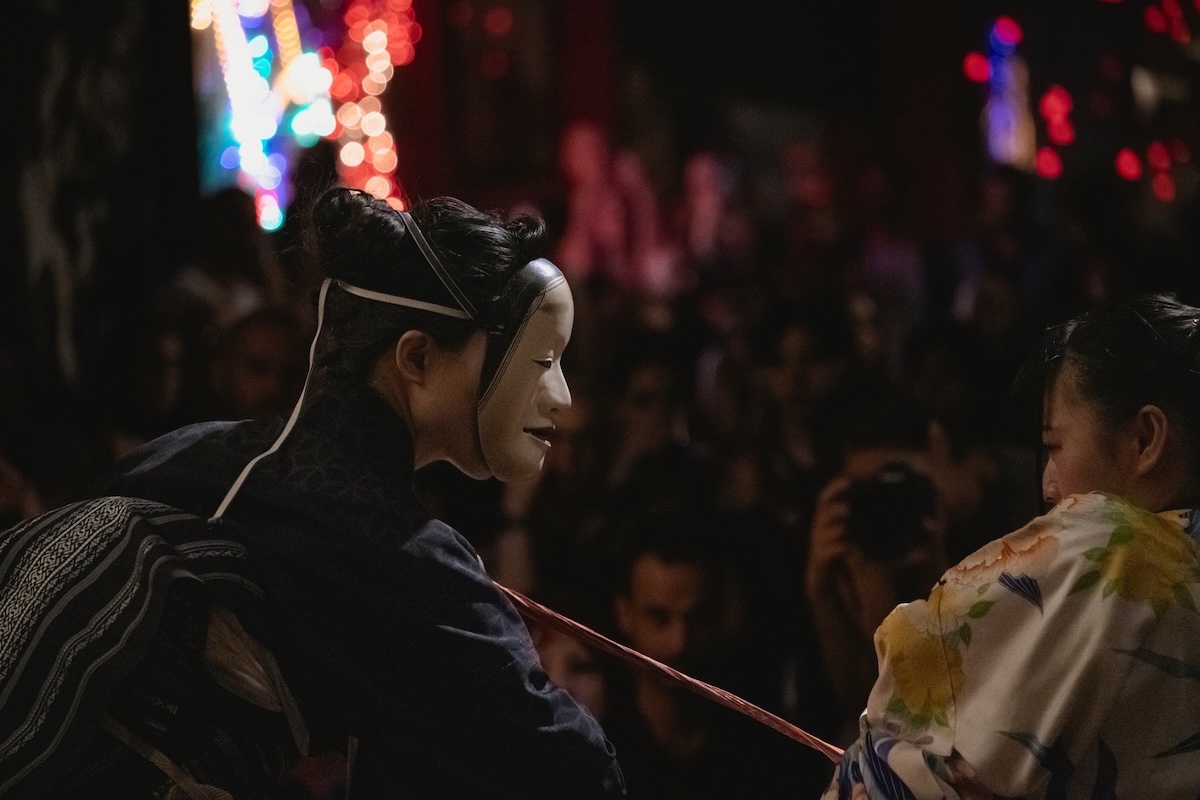
Mie: Note: ‘Wabi’ meaning ‘desolation’ and ‘sabi’ meaning ‘rust’, these words are used to describe ‘an aesthetically pleasing rusticity; similar to the beauty of antiques or historic buildings.’
‘Because we don’t have to reach a conclusion about what a particular word means, we can forever ponder and pursue the joy of words.’ This idea itself is a uniquely Japanese cultural philosophy and the way we Japanese enjoy language. We Japanese don’t see the lack of a correct answer as an inconvenience; rather, we tend to cherish it. Perhaps this habit of not defining language has arisen because we are a homogeneous people with a long history.
Many Westerners probably believe that even if it’s a different culture, there must be some degree of possible explanation that can be put into words. I feel like they assume that someone like myself, a Japanese person who specializes in teaching culture, can give them the best answer. Perhaps they also want the ‘correct’ answer put into words immediately.
However, there’s a big difference in values between Japanese people, who believe that it’s fine for each person to have a slightly different interpretation of a word (such as wabi–sabi, a unique Japanese term) and Westerners, who want the correct answer to be instantly understood. Conveying cultural concepts with words alone is also extremely difficult. Because it’s so difficult, I sometimes use pictures and videos in workshops to illustrate my meaning.
I spent about a week thinking and rewriting my answer to your first question, ‘How difficult is it to teach Westerners about the cultural aspects of Japanese Kinbaku?’ but even so, it’s so difficult that I feel like I might only be able to convey a small part of it.
Sin: Could you explain how Japanese culture (such as wabi–sabi) influences your style of kinbaku and what similarities there are?
Kasumi: Yes, this is something that I have used as a theme in my lessons for many years, in addition to technique. Today, I will use wabi–sabi as an example to explain just a small part of the influence of Japanese culture on kinbaku.
First of all, wabi–sabi itself is not something that can be understood all at once; it is a sense, something that is gained over a lifetime through repeated exploration of everything (art, aesthetic beauty, one’s own relationships, and the spirit of digging deep into one’s own inner emotions), gradually increasing one’s awareness of the meaning of wabi–sabi, culture, and aesthetic sense.
Repeatedly tying a partner over time, doing kinbaku together, you discover and affirm not only the other person’s essential desires and the beauty of the rope itself, but also the beauty that comes from within. You discover the similarities and differences in your relationship and way of thinking and you humbly enter into the other person’s mind, deeply pursuing, with a humble heart, the beauty that emerges from within that person’s unique inner self. This repetition itself is what is referred to as ‘Kinbaku with wabi–sabi’ from a spiritual perspective.
Next, I will discuss the commonalities of ‘wabi–sabi’ and kinbaku from a technical standpoint. One example of wabi–sabi tying is when the left and right sides are not symmetrical. In Japan, we deliberately do not aim for symmetry in a composition, art or kinbaku. There is an art technique based on the idea of deliberately damaging perfect beauty, of leaving it unfinished. It’s precisely because the composition is left seemingly incomplete that the viewer or the person being tied can use their imagination, increasing their appreciation of the work.
Imperfect beauty: the expression of beauty that emerges precisely because it’s asymmetrical. This, too, is the construction of beauty in wabi–sabi. The quickest way to understand this is to see and feel it with your own eyes, using photographs and actual demonstrations of kinbaku with and without wabi–sabi. If you want to see and understand the similarities, please come to my workshops. After all, it’s impossible to explain with words alone.
As a side note, the kinbaku practiced around the world today originated in Japan, but from there, various schools have sprung up, and I believe there are an infinite number of techniques. I believe these can be broadly divided into two categories of Modern Kinbaku and Classical Kinbaku.
Modern Kinbaku has been distilled to the point that there is a manual for achieving each harness and knit perfectly, making it highly reproducible, and there are specific standards for judging the level of students. The visual characteristics of Modern Kinbaku include symmetry and involve joining ropes, which makes it highly reproducible. Moreover, because it uses metal items like carabiners, even people with little strength can suspend their partner with relative ease, which I feel is very logical.
Classical Kinbaku does have prescribed formats for the chest harness (TK), various hip harnesses, and leg ties, but only the bare minimum is standardized. This allows for a high degree of freedom beyond the basics, allowing each individual to express their own unique style. The ‘finished product’ changes slightly each time. For example, the suspension rope is deliberately angled rather than perfectly vertical. This incorporates asymmetrical beauty reminiscent of ikebana, a flower arranging style that embodies the aesthetic sense of Japanese culture. Classical Kinbaku is characterized by its deeply Japanese aesthetic. Because there are very few standard harnesses/ties, Classical Kinbaku relates deeply to one of the concepts of wabi–sabi. That is ‘a fleeting beauty that never stagnates, like the scenery of the four seasons, changing with each passing season,’ also the fact that this ‘beauty can only be achieved with this shibari this time; the exact same shape will never be achieved again.’
Many schools of Classical Kinbaku have no concept or set a precise requirement for ‘levels’, refusing to set a ‘completion’ or clearly delineate a student’s level. Therefore, in Classical Kinbaku it’s not enough to simply memorize and reproduce a certain form the same way every time; Classical Kinbaku is ‘endless’. The idea of ‘there is no end’ is also found in wabi–sabi, in that there’s ‘no end to the answers.’ Because neither art nor Classical Kinbaku has an end, they can be enjoyed forever, and it also allows the person tying and the tied to each have their own original individuality, uniqueness, and different forms and ideas more than Modern Kinbaku allows for. This is a distinctive feature of the Classical Kinbaku I currently practice, which incorporates very Japanese ideas. Personally, I prefer the classics, so I use classical bondage, a technique that incorporates wabi–sabi in its design.
It’s not a question of whether Classical or Modern is better or worse, or whether rope with wabi–sabi or without is better, it’s all a matter of preference. In my personal opinion, I believe that Classical Kinbaku shares many similarities with Japanese culture, spirit, aesthetic sense, and aesthetic beauty. It’s impossible to explain all the commonalities in words, so if you’re interested, please come learn from me. I’ll explain things in an easy–to–understand way, using demonstrations and videos.
Sin: Do you incorporate Western influences into your kinbaku?
Kasumi: Yes, very much!
Westerners are very unique and original. Practitioners of Classical Kinbaku often believe that ‘everything starts and ends with the gote (arms restrained behind the back)’, but it seems that there are many new ideas in the West that break away from this old Japanese concept. They even create original ropes other than the TK (an acronym that came from Takatekote, or hands crossed high behind the back). Westerners are very creative and their work is high level.
To be honest, I wasn’t particularly interested in shibari other than TK in the past, but recently I’ve really enjoyed exploring styles other than the TK. Moreover, unlike Japanese people who are shy and have difficulty expressing their feelings directly, in the West, both partners are able to communicate naturally and fully. Their skill at praising the good parts of others and helping each other improve is far superior to Japanese people. This difference in emotional expression between Westerners is very inspiring to me. I’m not very good at expressing my feelings in the moment, but I’ve learned a lot about the importance of communication, and I’ve incorporated Western influences into my work.
Sin: What are your future goals?
Kasumi: 2026 will mark the 28th year I’ve been working professionally, and I’d like to travel the world in good physical and mental health, spreading the word about Japanese kinbaku, at least until I reach the 30–year milestone. I want to enjoy kinbaku until I’m exhausted. I have five long–term goals.
First, I want to pass on to the world my stories of my experiences with the legendary kinbaku artists who have already passed away. Those were truly invaluable experiences, and I want to share the joy and uniqueness of kinbaku from that era with people all over the world.
Second, I’m currently partnering with Japanese private medical professionals to conduct research to minimize kinbaku accidents (mostly numbness and nerve damage in the arms). Over the past three years, I’ve seen some success. I’d like to share my research on injury prevention measures and numbness management. I also want to promote the importance of mental–health care.
Third, I want to spread the concept of Kasumi Style, which is the fusion of Japanese culture and kinbaku. I want to put into words the way that Classical Kinbaku is connected to culture in a way that’s easier to understand. It’s not just about memorizing the shapes of ties and knots, there is a proper reason why they were invented that way. The kinbaku that we do now isn’t just something we perverts came up with; many of the basic kinbaku methods are traditional tying and fastening methods from traditional Japanese culture. The final knot that holds the obi of a kimono is tied using a honmusubi, or square knot. Japanese people have used this knot since ancient times when wearing kimono. This method of tying has been adopted by people who practice kinbaku. There are many acts of tying within Japanese culture, and many of these tying and fastening methods have been appropriated by kinbaku practitioners. Properly learning this cultural background, rather than just having classes where you memorize the shapes, gives you a glimpse into the psychological depth of rope work and definitely increases the enjoyment of rope.
Fourth, I have about 10 years of professional experience as a model. From age 35 to 45, I worked professionally as both a Kinbaku artist and model. From age 18 to 34, I was exclusively a professional Kinbaku artist. I’m the only Japanese bondage artist with such an unusual background who works overseas. Therefore, the technical improvements and spiritual insights I have gained came from both the perspective of tying and being tied, which are things only I can share. I hope to share these with the world.
Fifth, this may seem obvious, but even more important than technique or culture, I want students to always remember that rope work is about both happiness and enjoyment, and not get too caught up in technique, or formality or intellectual thinking. I want to always encourage people to enjoy rope work. Akechi–sensei often asked, “Do you enjoy rope?” Learning techniques is fun, so it’s easy to get caught up in pursuing technique as if it were an exam. But I want to encourage you to never forget why you first became interested in tying people with rope.
My immediate goal this year is to focus on training instructors and students who will continue to teach the Kasumi Style – a collective term for these ideas and techniques, even after I retire.
Kasumi Hourai
- Website: https://kasumi1200.myportfolio.com
- Instagram: kasumihourai_ropeart
- X: @kasumihorai78
Mie
Mie is a bilingual BDSM translator and personal tour guide in Nagoya, Japan. She offers English Japanese translation for private rope lessons, rope salons, and events.
- Website: https://mieshibari.com/
- Instagram: @mie_shibari
- X: @mie_shibari